
The Cost of Looking Unharmed
The world extends its tenderness to what it can see. Invisible wounds don't come with that grammar. And to be believed, you must explain. You must open the wall again, let the water show itself, pay the cost of telling. We would never ask this of the physical. We would never say: break it again, so we can see.
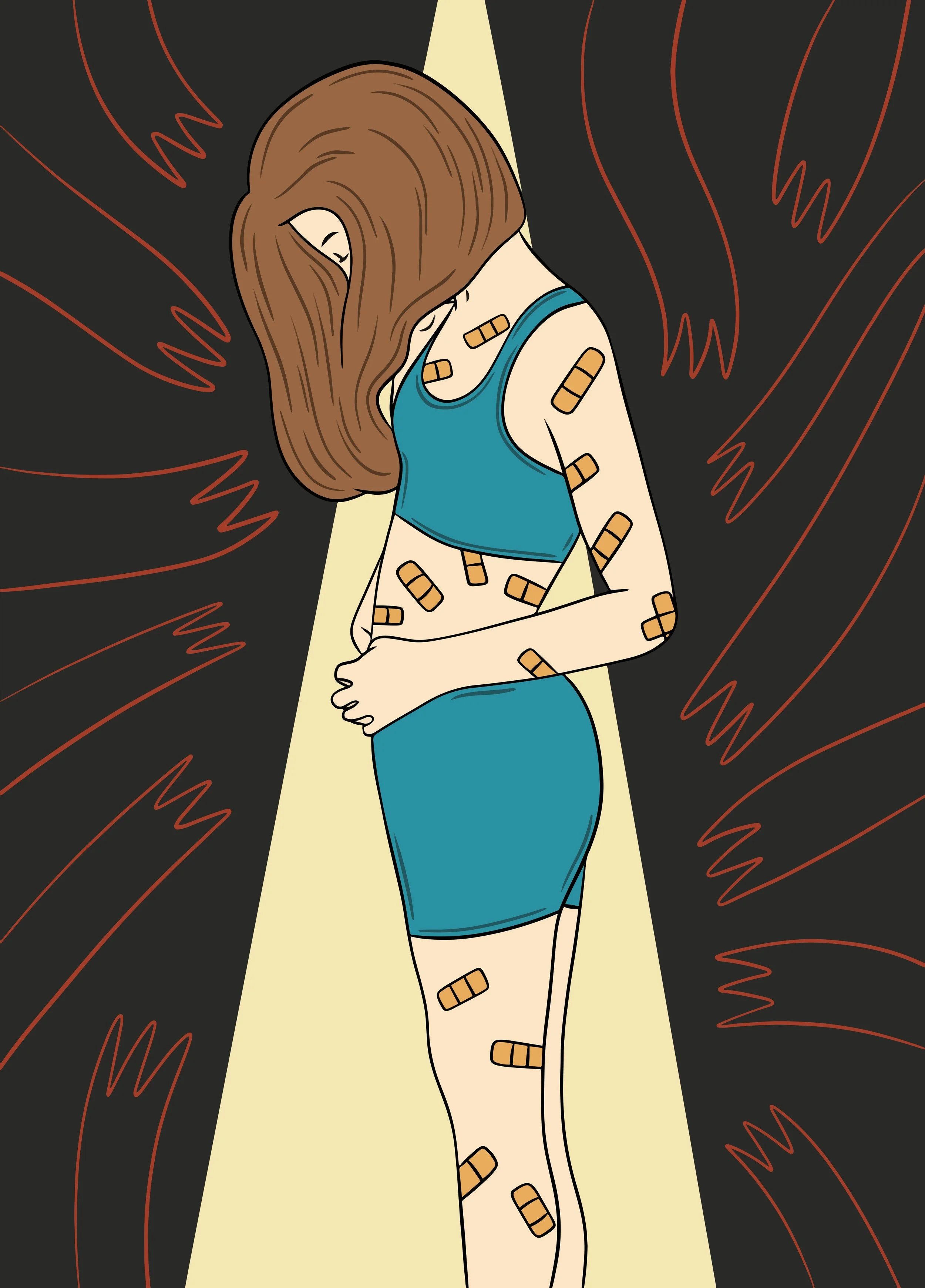
There was a season when everything seemed to unthread itself. Though one hesitates at the word season, with its tidy implication of beginnings and endings. Damage does not observe calendars. It seeps the way rain enters soil, the way water enters walls, the way wind dismantles cliffs so gradually that the cliff does not know it is becoming something else. I held my face correctly through all of it. Kept my voice at the right register. Showed up. Continued. For I had learned, over many years and at an expense that cannot be tallied, that the world has a grammar for visible suffering but no syntax for the invisible. One learns, early and thoroughly, not to speak in a language no one will read. So I spoke nothing. And nothing was read. And we proceeded.
And yet the water was moving. This is what walls know that the world does not: that the damage need not announce itself to be doing its work. That the surface can remain presentable, the face correct, the voice measured, while somewhere in the interior the slow patient work of erosion continues, finding the next crack, widening it, moving through.
The world extends its tenderness to what it can see: the fractured limb, the scar that earns a pause and a softening, the limp that clears a path without asking. These gestures exist because the wound fits a system the world already knows how to read, because the cast makes its argument without needing to be believed, because the evidence is there on the surface where the instruments can reach it. Invisible damage asks something the world has never been taught to give: the willingness to feel what it cannot see, to extend care toward what offers no proof, to believe in a weight that casts no shadow. And this, it turns out, is a different skill entirely. Rarer. Almost no one has been taught it.
To be known is not the same as being felt. I know this because I was the wall.
People can hold your entire history in their hands. Every room, every seam, every place the water entered; and still reach instinctively for the instruments the world gave them. Still measure what is visible. Still expect recovery to look like recovery. They were not cruel. They were simply equipped for a different kind of wound, trained on evidence that presents itself plainly, that does not require imagination or the particular exertion of feeling what you have only been told. And so the invisible wound does something the visible wound does not: it recruits doubt as a second instrument of harm. The wall begins to wonder if it is, in fact, a wall. If the water is, in fact, water. If what is happening inside is as serious as it feels, or whether a sturdier structure would simply not be affected. Am I imagining this. Is this as bad as I think. Would a stronger wall have held. The damage moves inward and begins to do the world's work for it, and this — this is where the real erosion happens, not in the original wound but in the slow convincing of the self that the wound is not real.
Virginia Woolf, writing from her sickbed, understood that suffering relocates you to a country the healthy cannot enter, with its own altered landscape, its own sense of time stretched thin as membrane, largely untranslatable across the border. You did not apply for citizenship in this country. You were simply deposited there one season, without a map, without a passport, without anyone to confirm the territory exists.
“Arrange whatever pieces come your way.”
And the cruelty particular to this country is the cruelty of proof. That to be believed you must explain, and to explain you must open the wall again, let the water show itself to an audience that may look and still see nothing. We would never ask this of the physical. We would never say: break it again, so we can see. And yet this is precisely what the invisible wound is asked to do, every time, by every person who requires evidence before they can extend the grammar of care. So you either stay silent and remain illegible, or you tell it and pay the cost of telling, the water rushing back through the opening you made for their benefit, and still — still — might not be believed.
Hilary Mantel lived inside this cruelty for years, her pain attributed to hysteria, her reality disputed by people with institutional authority to define what is real, her endometriosis invisible to every instrument brought to her body while she stood there, holding her face correctly, functioning, continuing, surviving in all the ways the world could measure and suffering in all the ways it could not. What she describes in Giving Up the Ghost is not the pain itself but the secondary wound: the violence of a world that looks at your functioning and concludes there is nothing wrong. The damage recruits doubt. The doubt recruits silence. And the silence is so well-maintained that when someone finally looks, they see only a wall, intact, presentable, doing its job.
For the invisible wound, functioning is often the scar. The hypervigilance, the performance of okayness, the constant translation of the interior into something the world will accept without discomfort — these are not signs of recovery. They are signs of a wall that has learned, with extraordinary precision, to hold its shape while being hollowed. You survived by learning to look unharmed, and the world looked at you looking unharmed and called it recovery, and somewhere inside the wall the water kept moving, patient and certain, finding the next crack, widening it imperceptibly, moving through. There are rivers that have been carving the same canyon for ten thousand years. No one watched them begin. The canyon simply deepens, in the dark, in the silence, with complete indifference to whether anyone will ever stand at its edge and understand what made it. This is what the water knows. This is what the wall knows. That the work is real whether or not the world has instruments to measure it.
Ocean Vuong writes about inherited damage, and what strikes me in On Earth We're Briefly Gorgeous is not the damage itself but the fluency it produces alongside the cost. The child who learned to read the temperature of every room in order to remain intact becomes the adult who perceives the hidden fissures of strangers, the water moving behind their walls, the crack that is widening behind a smile held correctly at the right register. The hypervigilance that exhausts also illuminates. The person who spent years mapping the distance between what is felt and what can safely be shown develops a second sight for other people's illegibility — involuntary, precise, relentless — a fluency in the language of walls.
There are stars whose light takes so long to reach us that by the time we see them they no longer exist. We are looking always at a record of something that has already happened, at burning that was real, at a source that may be gone, and the light arrives anyway, faithful and indifferent, crossing distances that dwarf every human measure of suffering and time, to reach an eye that may glance up for a moment, and look away, and never know what it witnessed.
The survivor carries something like this — not metaphorically but structurally. Each scar a canyon whose forming no one watched. Each ache a tide running on its own schedule beneath a surface that appears calm. Each memory a light still travelling, arriving sometimes in the middle of an ordinary afternoon without warning, illuminating something the world will never see because it was not there when the burning happened and does not know to look.
And what the world will never name is this: that the wall, in learning to hold its shape while the water moved through it, developed a cartography the world did not give it and cannot take from it. A fluency in what cannot be shown. An ability to sit with someone in their illegible pain and not ask them to explain it, not require them to open the wall again so you can see; because you already know the feeling of water moving through, because you have traced those corridors in the dark, because you know the country by heart. This is not wisdom the world offered. The world offered nothing. No cast, no softening, no pause, no neighbours at the door with casseroles. The canyon deepened without applause. The light travelled without an audience. You cooked, fed, worked, showered, lived. The wall held its shape without anyone thinking to ask what holding costs.
The universe does not require a witness. Rivers carve without consent. Stars burn without permission. Tides rise and fall with complete indifference to whether anyone is watching, whether anyone believes in them, whether anyone has the instruments to measure what they do to the shore. And the wall endures in this same register. Not because anyone cleared the path, not because the grammar of care was ever extended, but because the water, for all its patience and certainty, did not win. Because somewhere in the slow geological work of continuing to be a person, of holding the face correctly and keeping the voice at the right register and showing up and continuing, the wall became something the water did not intend: a record. A cartography of invisible forces. A canyon that took ten thousand years to make and will outlast every instrument that failed to see it forming.
The light is still arriving. The canyon is still deepening. And the wall stands, as it always has. Not despite the water, but because of it, shaped by what moved through it into something the world has no grammar for yet, but which is, nevertheless, and entirely, and without requiring any proof at all, real.
