
The Useful Ghost: Walking Pulau Ubin
I had come to Ubin expecting to find something slower, softer, more human. And I had found all of that. But underneath it, something I hadn't expected: the faint discomfort of realising that what I was calling slowness was, in fact, curated. That my sense of having escaped, however briefly, had itself been arranged.
The rain had just stopped. The sea behind us was still rough, still salt-thick and seemingly indifferent to the wooden boat that had carried us across in ten minutes of wind and spray. Then the boat knocked against the jetty and we stepped onto ground that was wet, and a scene that matched my imagination: uneven road, bicycles stacked and leaning, signage nailed to tree trunks, sheds, food carts. An unhurriedness. The permission to not move at the speed of the island visible across the strait.
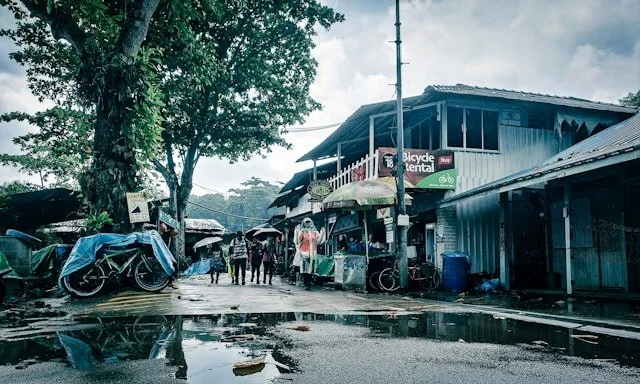
We walked. The road was slightly uneven, and trash collected at the verges. Not a lot, just enough to notice. Enough to remember that you don't see trash like this across the strait, where cleanliness is infrastructure, where the visible disorder of living has been systematically removed from public space. Here it remained, and I found I didn't mind it. It felt, strangely, like evidence. That this was a place still inhabited by actual life, not the performance of it.
The houses sat back from the road. Zinc roofs. Wooden walls the colour of long exposure to weather. Fruit trees pushing through whatever gaps they'd found. Some houses were clearly empty with their doors padlocked, windows filmed with dust. Others showed small signs of occupation: a pair of sandals, a plastic chair, laundry still damp from the morning's rain. I stood and stared like embarassing tourists occasionally do. I wondered with it must feel like to come home to this. To not be greeted by lifts and buttons — but plants, verandahs, being able to announce my arrival out loud instead of ringing a digital bell.
We moved uphill. The road narrowed. Trees closed in on both sides. Angsana, tembusu, all the trees we learned about from textbooks in the eighties and have rarely stood beneath since. The canopy made me aware of my own smallness without making me feel diminished by it. The air changed quality. Cooler, thicker, smelling of wet earth and something I didn't have a name for. I noticed, somewhere along that climb, that I had stopped thinking about time.
That is not a small thing, for someone from across the strait.
The path wound past a temple. Small, with a red lantern dulled by weather. Joss sticks still burning despite the rain, tended by hands I didn't see. I found myself thinking, as we moved deeper in, about who this island is preserved for. Not for its residents, who live with limited services and infrastructure that ages without replacement. Not quite for the Singaporeans who come on weekends to cycle and eat and feel, briefly, that something has been saved. It is preserved, I think, as a kind of national alibi. Proof that Singapore didn't demolish everything, that there is still somewhere you can point to and say: this is where we came from. Ubin functions as a memory prosthetic. The island doing the work of remembering, so that the city across the strait doesn't have to.
And the city needs that. Needs Ubin to be slightly melancholy, slightly inaccessible, slightly outside time. The contrast makes its own efficiency feel like progress rather than loss. A useful ghost.
Further in, the sounds changed. The bicycles and the hawker carts fell away, and what replaced them was not silence exactly. There were the birds, insects, the slow drip of water from leaves still shedding the morning's rain, but also an absence. The absence of the constructed sounds that constitute modern life. No polished surface reflecting light back at you. I became aware of my own footsteps that landed with a crunch rather than the urban clip my ears were accustomed to. And of my own breathing. There is something the body knows in spaces like this that the mind takes longer to articulate. Recognition that goes deeper than memory. Cellular, almost.
Which made the silence feel less like peace and more like grief.
You can maintain the husk indefinitely. The living thing has already left. The kampung that once animated these zinc roofs, these fruit trees, these padlocked doors, its sounds, its rhythms, the texture of its daily life; is gone. What remains is the outline. The room after the furniture has been removed. I walked past each slowly, aware that I was experiencing not a place but the memory of one, and that the memory had been carefully tended so that the loss would not feel too much like loss.
By the time we turned back toward the jetty, the sun had broken through. The strait glittered. Across the water, the city skyline rose sharp and certain and immense. Home; all glass and vertical ambition, a skyline that has practised being seen. I looked at it for a long moment. Then I turned back to the island behind me. The wet road. The leaning bicycles. The trees.
I had come to Ubin expecting to find something slower, softer, more human. And I had found all of that. But underneath it, something I hadn't expected: the faint discomfort of realising that what I was calling slowness was, in fact, curated. That the island I had found restful was restful in the way that things are when they have been orchestrated to appear untouched. That my sense of having escaped, however briefly, had itself been arranged.
The boat back was quieter. The sea had settled. I watched the island recede. Its tree line, its zinc roofs, its red lantern somewhere in the interior still burning and felt, as I sometimes do after encounters with places that carry more weight than they appear to. I became aware that I had not fully understood what I had been given. Only that I had been given something. And that it would take time to know what to do with it.
