
I Have Not Begun
The nervous system, ancient and efficient and not remotely interested in your analysis of it, cannot tell the difference between a pigeon and a person. It only knows that something came before. Something might come again.
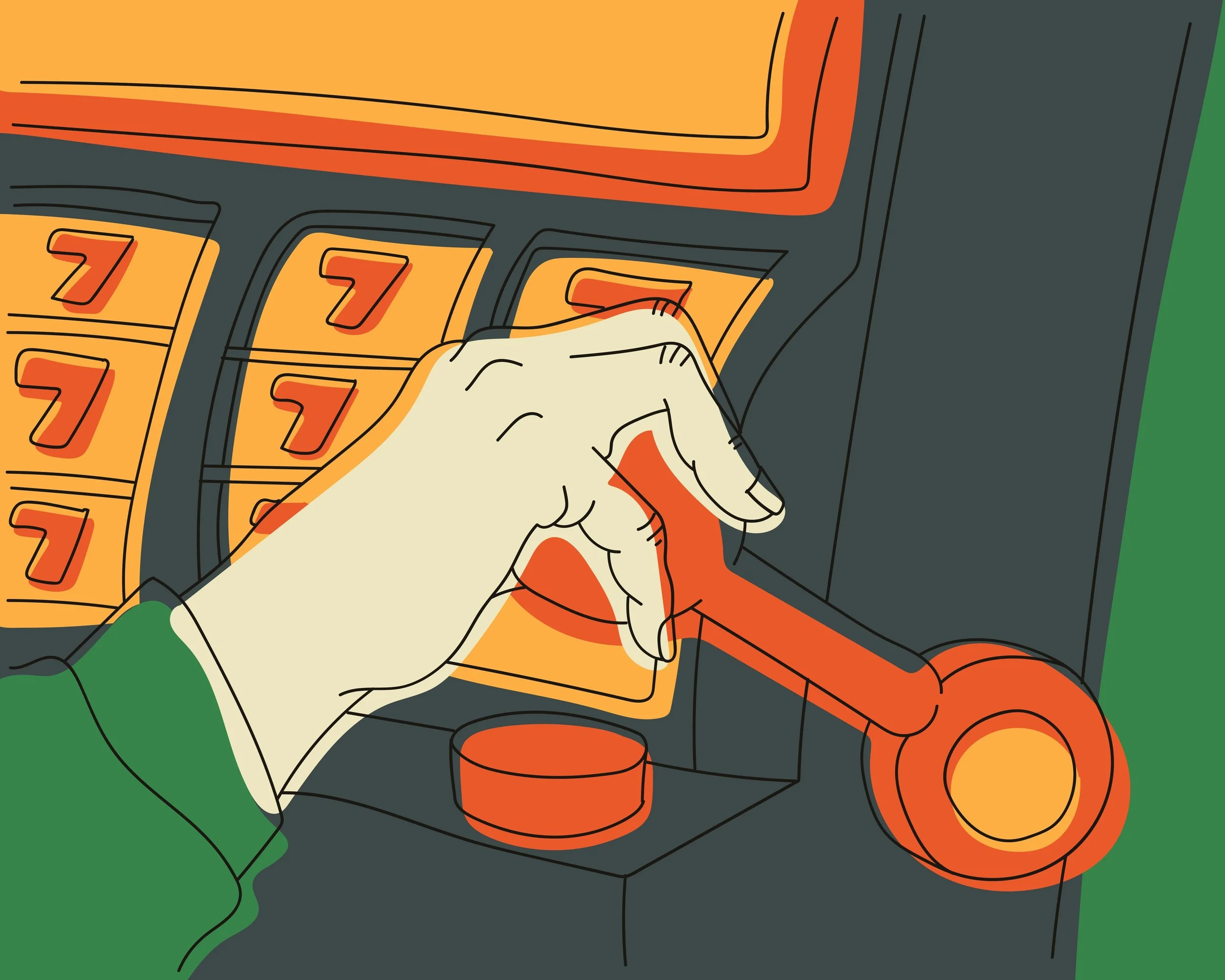
In 1948, B.F. Skinner placed a pigeon in a box. The box had a lever. When the pigeon pressed the lever, a food pellet appeared. The pigeon learned quickly that if it pressed the lever, it would receive the pellet. Reliable, predictable, efficient. And crucially: when Skinner stopped delivering the pellets, the pigeon stopped pressing. The behaviour extinguished. Why would it continue? The signal was clear. Nothing here.
Then Skinner changed the schedule. Same lever, same pigeon, but now the pellet appeared unpredictably. Sometimes on the second press. Sometimes on the fiftieth. Sometimes not for a long time, and then twice in a row, and then not again. The pigeon could not learn the pattern because there was no pattern. And what happened was this: the pigeon pressed the lever more. With greater urgency, greater persistence, longer into apparent futility, more resistant to extinction when the pellets stopped entirely.
This is called variable ratio reinforcement, and it is the operating principle of every slot machine ever built, of social media feeds, of the specific and exquisite suffering of loving someone who is sometimes, unmistakably, entirely there — and then isn't — and then is again — without pattern, without warning, without enough absence to allow the body to conclude that nothing is coming.
Casinos understood this before the psychologists named it. No clocks. No windows. No way to measure how long you have been sitting there, how many times you have pressed, how far the evening has gone. Just the machine and the lever and the next attempt, which might be the one. The design is not accidental. The almost-win is more addictive than the win. The reward dispensed just often enough to prevent you from leaving.
The nervous system, ancient and efficient and not remotely interested in your analysis of it, cannot tell the difference between a pigeon and a person. It only knows that something came before. Something might come again.
Keep pressing.
This is not, it should be said, a flaw. It is the mechanism that kept every ancestor you have ever had alive. In an unpredictable environment, and in every environment our nervous systems were built for was unpredictable, the creature that kept trying after failure survived. The one that stopped, didn't. Persistence in the face of intermittent reward is not irrationality. It is the oldest intelligence there is.
Foraging animals do this. Return to the same patch of ground that yielded food last season, and the season before, even when it is currently bare. The bluefin tuna crosses entire oceans following temperature gradients that sometimes lead to abundance and sometimes don't. The crow remembers every cache it has ever made, returns to each one, checks. The mechanism does not ask whether the effort is proportionate. It only asks: did something come before.
We built the casino on top of this. We did not invent the vulnerability.
I know this. I have explained it to myself carefully, more than once, in the tone one uses when one is trying to be helpful to oneself. It has not helped.
This is what self-help, and the entire architecture of contemporary introspection — the journaling, the naming, the beautiful diagrams of attachment styles shared in squares on the internet — sidesteps: knowledge does not interrupt the mechanism. It runs alongside it. A commentary track on a film you cannot stop watching. You can name each moving part with clinical precision, and the mechanism continues, unimpressed, the way a river continues after you have correctly identified it as a river.
I have identified this river many times.
Kierkegaard wrote about what he called the aesthetic stage of existence. The mode of selfhood organised around experience rather than commitment, around the refined appreciation of one's own inner life. The aesthete, in his formulation, is not shallow. Often the opposite. The aesthete observes, reflects, articulates with great sophistication the nature of what she is feeling. She is, in some ways, the most self-aware person in the room.
And this is precisely the trap.
The articulation becomes its own destination. Once you have named the thing beautifully, you have, in some obscure way, discharged your obligation to it. The insight substitutes for the change rather than producing it. You have felt the feeling about the feeling. The sadness of recognising the pattern, the clarity of seeing it whole, and that secondary feeling uses up the energy that might otherwise have moved you to act.
He was not flattering us.
Simone Weil believed our fundamental problem was that we do not know how to pay attention. Not the anxious, acquisitive kind of looking — what does this mean for me, what do I do with this, how does this fit with what I already think — but something far more difficult. An emptying. A patient, deliberate suspension of the self's appetite for conclusions. She called it, without embarrassment, a form of prayer. And the implication threaded through everything she wrote is this: understanding is not attention. Understanding appropriates. It takes the phenomenon, processes it, files it under a known category, and in doing so, renders it safe. Managed. No longer demanding. You have understood the lion, and now it cannot bite you.
Except it can.
I have filed this. I know what a childhood of preempted wanting does to the wanting-muscle over decades: how desire, never practiced, never fed back into itself, atrophies; of the way a language you studied but never spoke slowly becomes a language you can read but can no longer hear yourself think in. I know why intimacy terrifies the person who never learned that arriving fully was something they were permitted to do. I know why some give in to flashes and retreat before these flashes can be named. I know why I cannot be angry at these and why not being angry costs something I do not have a word for.
I understand the whole architecture.
And yet.
There is a concept in thermodynamics called activation energy. It describes the energy required not to complete a reaction, but simply to begin one. A system can be primed for transformation by having every condition met, the outcome more stable than the current state, the change thermodynamically inevitable; and still nothing moves. Not until something arrives to push it over the initial barrier. The reaction does not know it would be better on the other side. It only knows the cost of the threshold.
The knowing is not the activation energy.
I think about this when I try to understand why knowing does not change things.
The knowing is not the activation energy. It is more like a detailed map of the reaction. A description of what the new state looks like, where the barrier is, how high. Extraordinarily useful. Does not push me over. I can study the map indefinitely. I can add annotations. I can become the world's foremost expert on the topology of my own impasse.
And there I will remain, expert and stationary, on the wrong side of the barrier.
William James thought habit was the flywheel of society. The mechanism that holds the structure of daily life together without requiring constant acts of will. You do not choose to find your way home. You do not choose to reach for the familiar. The body has learned, and the learning runs without consulting you, which is mostly a mercy, which is what allows a life to function. But the same mechanism runs the patterns you have decided to stop.
James was specific about what this means and costs. Every resolution made and not acted upon does not leave you neutral, it leaves you worse. The unkept promise to yourself sediments. Adds its weight to the groove. The knowing-self and the doing-self are not the same self. They barely share a language. One makes declarations in the daylight; the other wakes before dawn and does what it has always done, indifferent to last night's clarity.
To change, James said, you had to begin immediately. Not plan to begin. Not understand more fully why beginning mattered. Begin — put the body in the new position before the mind had time to construct its objections. Because the mind's objections are endless and exquisitely reasoned. And the body is the only thing that cannot be argued with.
I have read this. I have understood it. I have found it clarifying and correct. I have not begun. I have, however, written extensively about not beginning.
The Buddhist traditions go further than James, which is saying something. They are not interested in the knowing-self at all, not as an agent of change. What they are interested in is samskara. That which are the grooves worn into the mind by repeated experience, the channels that direct the flow of thought and feeling the way a riverbed directs water.
You did not choose the riverbed. It formed over time, from the accumulated weight of every experience you have had and every response you trained yourself into. And here is the part that understanding cannot touch: the grooves are not in the mind as a concept. They are in the tissue. In the specific firing patterns of specific neurons worn smooth by use. In the body's knowledge, which is older and more patient and considerably less interested in insight than you are.
To change the grooves, you do not think different thoughts. You practice different actions. Repetitively. Physically. Over a long time. Below the level of comprehension. The understanding can tell you this. The understanding cannot do it for you. And writing this, I notice I am doing it again. The filing. The naming. The beautiful diagram.
And somewhere in that gap between the map and the territory, between the description and the thing described, between knowing and being otherwise… that spot does not have a word.
Portuguese has saudade. That which is the longing for something loved and absent; but that word dignifies you with a clear object and a clean loss. Something was there and is not. You know what you are mourning.
Saudade is a complete sentence.
What I am describing is not absence. Absence could be named, mourned, adapted to. The body would know what to do with absence. That is to register the deficit, redirect the investment, close the loop. It is designed for this. It is very good at it.
What I am describing is intermittent presence. Enough arrives to prevent collapse. Not enough to resolve into stability. And so the mechanism — the old efficient mechanism, the pigeon and the lever — keeps running. Keeps scanning and performing, without acknowledgment and without cessation, the labour of sustaining a possibility against the available evidence.
There is no word for this because it should not exist. You should not be depleted by the almost. The almost should not count. And yet here is what I know: it counts. It counts in the body before it counts anywhere else. In the tightening that is not quite pain and not quite anticipation. The readiness that does not switch off in stillness.
This is not sentiment. This is physiology. This is what a nervous system does when it has learned, below the level of any decision, that the next moment might be the one that delivers.
It does not stop because it has been correctly identified.
So here we are.
I know about the pigeon and the lever. I know about Kierkegaard's aesthete and the exquisitely articulate entrapment. I know about Weil's attention and its difference from understanding. I know about activation energy and the thermodynamics of staying put. I know about James's flywheel and the futility of resolution without act. I know about the grooves in the tissue and the long work of wearing new ones.
I know what this is. I know why it continues. I know what it costs and where it lives and what would have to happen for it to stop.
I knew all of this before I started writing.
I will know all of it tomorrow.
And the day after that something in my chest will do what it always does, the old faithful thing, the thing that does not read, does not learn, does not care at all what I know —
and I will feel it anyway.
Still, somehow, each time, a little surprised.
