
The Waggle Dance of Unlived Sweetness
In 1973, Karl von Frisch deciphered the honeybee's waggle dance: A worker lives six weeks, visits a million flowers, yields one-twelfth teaspoon of honey she never tastes. Like Dickinson's bee jarring across plush tracks to plunder velvet masonry, hers is motion without interval: sweetness becomes signal before it can settle as its own radiance.
In 1973, Karl von Frisch received the Nobel Prize for unraveling one of the most astonishing systems of communication in the natural world. A honeybee returning from the fields performs the waggle dance, that remarkable figure-eight choreography on the vertical face of the honeycomb, in which the angle of the central run becomes direction, the duration of the waggle becomes distance, and the invisible geography of flowers is translated into a code the hive can read. What seems at first like instinct, or ornament, or merely the beautiful excess of creaturely motion, turns out to be something far more exacting and strange: a grammar of survival, a way of making the world shareable.
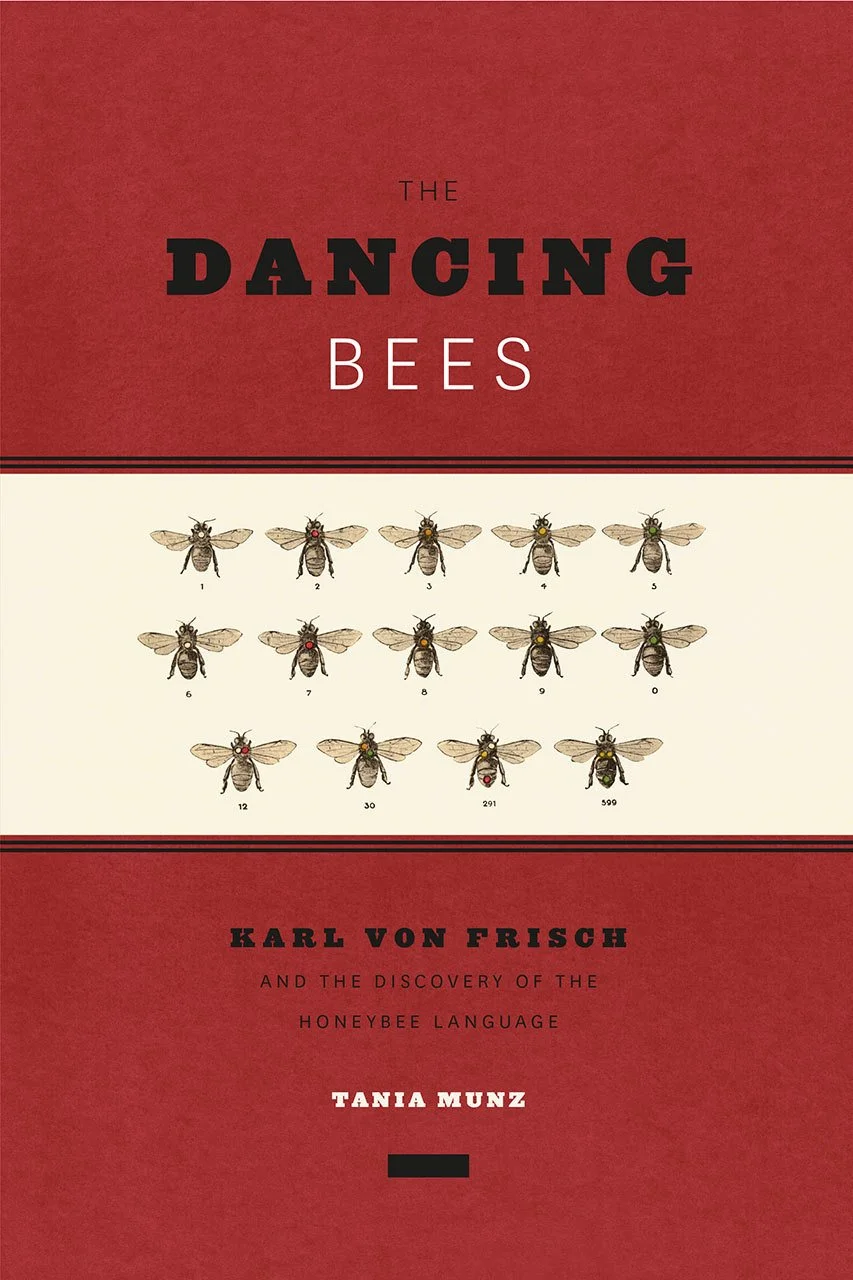
Tania Munz’s The Dancing Bees enlarges the story beyond a single scientific breakthrough. It is also a book about how hard it is to pay attention well, and how strange it is to encounter a form of intelligence that does not look anything like our own. The bee’s dance becomes more than a marvel of biology. It is a reminder that meaning can be present before we know how to read it, and that the world is often speaking long before we have learned its language. Through that small, precise movement, something is bridged between the flower and the hive, between one life and another. The world is discovered and communicated.
And yet the bee’s life is so short, so disciplined by necessity, so nearly vanishing in its devotion. A worker bee in summer lives only about six weeks. In that brief span she will make thousands of foraging trips, visit roughly a million flowers, and produce, over the whole of her life, only about one twelfth of a teaspoon of honey. The arithmetic is almost unbearably lopsided, as though the universe were asking for abundance from a creature allotted almost none of it. She spends herself in the making of sweetness and never tastes what she has made.
Beyond natural history, it speaks to the asymmetry of labour and reward, of contribution and recognition, and of how much of what sustains the world is produced by lives too brief or too small to receive the fullness of their own creation. The bee becomes, in the end, a figure of tragic generosity.
WHAT THE BODY LEARNS
She gathers what she cannot keep, makes what she cannot claim, and leaves behind a sweetness that outlasts her by far, a paradox of creation where the maker fades into the golden murmur of the hive, eclipsed by her own labour. This is not, in the biological literature, framed as loss or longing, but is the architecture of her function. The finding and the giving are not two acts divided by pause or possession. They are one continuous motion, one inexorable current flowing from petal to wing to waggle to wing again.
“Like trains of cars on tracks of plush,
I hear the level bee:
A jar across the flowers goes,
Their velvet masonry
Withstands until the sweet assault
Their chivalry consumes,
While she, victorious, tilts away
To perish, or to live.”
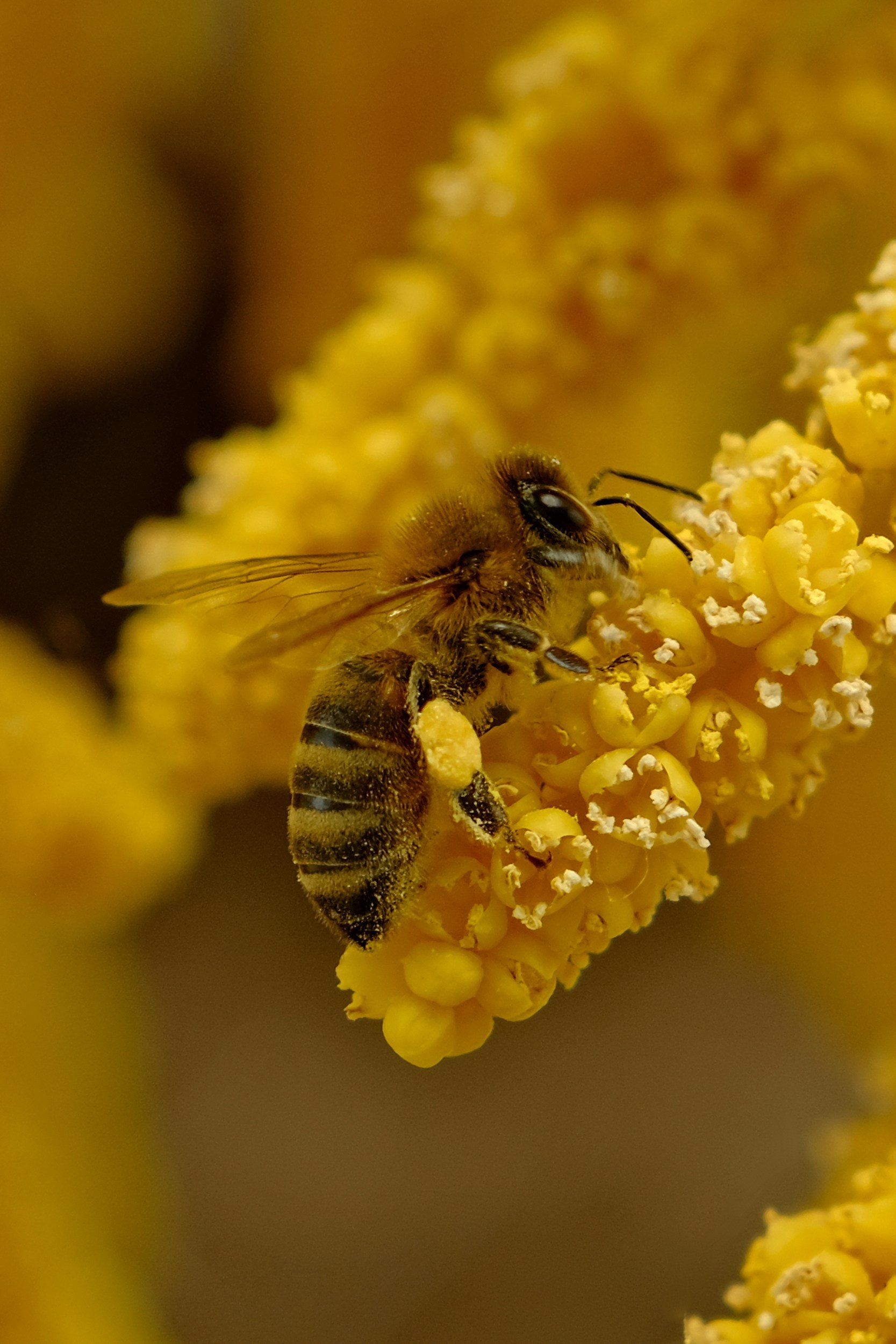
See how Dickinson catches it there, in that relentless traversal? The bee becomes a kind of mechanical pilgrim, her body a vessel crossing the plush fields to plunder and relay, the flower's velvet resistance yielding not to pleasure but to the next imperative. The bee's encounter with the flower stands organised from the first trembling contact around the transmission that must follow, as if the nerve and nectar were woven together before the bloom even opens.
What the research whispers, uncomfortably if you linger with it, is the absence of any true interval between sweetness and dance, no private moment where the flower is simply met, held, savoured as its own radiant fact before it dissolves into coordinates and code. The body, that ancient instrument, moves at once into translation, turning encounter into export, wonder into information.
And the nervous system itself, so perfectly honed across eons of such askings, learns precisely what it is made to do. Command it often enough to gather and relinquish, to find only in order to give everything away, and it complies with terrible grace. It grows virtuosic at the art of release. It forgets, in time, to register that anything was ever there to be kept, that the sweetness ever shimmered as anything but signal, anything but the raw material of the next departure.
This is not deprivation as we know it, not the sharp pang of absence or the hollow ache of want. It is something more obdurate, more difficult to name: the erosion of the interval itself. The gradual narrowing of that fragile space between discovery and dispersal, between the flower's kiss and the hive's decoding, until the space contracts to a vanishing point. Until it is so small it might as well not be, until the bee herself, if she could speak beyond her dance, could no longer tell you whether she tasted the flower before she turned it into direction and distance. For her, translation has become the experience.
THE LOOP THAT DOES NOT RETURN
Consider Ed Tronick's Still Face Experiment, where an infant meets the sudden blankness of her mother's withdrawn gaze. The small body folds inward. The reaching hand falters. The smile unravels halfway across the face. Tronick mapped not mere distress there, but the unraveling of a loop meant to circle back, the cost of a reaching that grasps only emptiness, a bid sent out that hangs unanswered in the air. The waggle dance mirrors this in reverse: a loop that extends outward and never returns to the dancer herself. She reaches for sweetness, gathers it, and the sweetness flows at once into motion, into the hive, into honey sealed beyond her reach. The loop completes, but not for her.
I have lingered with what it means to dwell within such a circuit as some deliberate choice. It feels truer to call it an early shaping of the self, a pattern that proved useful, gathered reinforcement over years until it hardened into what we name character. Until the one inhabiting it might say, if pressed, that they simply do not require much. That they are fine as they are. That meaning blooms in the act of giving, and the absence of return registers dimly, like a door in some long-unvisited room, glimpsed in passing but carrying no weight, no summons to enter.
Simone Weil called attention the rarest and purest form of generosity, holding it up as something luminous, almost devotional. She offered it as praise, but I have turned it over as caution, as something edged with peril. Weil knew this terrain from the inside, her own life bearing witness to its extremes: how a person can grow so adept at directing the gaze outward, so fluent in the labour of beholding others, that the muscle of turning inward withers away. From a self so long arrayed toward the world that its own depths begin to feel foreign, their grammar half-lost, their silences unfamiliar as a country one once passed through as a child.
WHAT THE FLOWER CANNOT KNOW
What interests me most is not the giving, but the interval before the dance begins. That fraction of time, if it exists at all, when the bee rests simply in contact with the flower. Not yet translating. Not yet shaping the encounter into something shareable. Just present. Just here, with this sweetness, before it turns to instruction.
Rilke, in his Letters to a Young Poet, urged: go into yourself. Not as self-absorption, but as the only honest beginning. The interior is not a distraction from the real work. It is the source of it. A person who has not learned to inhabit themselves has very little to truly give, however much they seem to be giving.
“The time will come when, with elation
you will greet the stranger
who was your self. Give wine. Give bread.
Give back your heart to itself,
to the stranger who has loved you all your life,
whom you ignored for another...”
The bee cannot read Rilke. She has no interior in the sense we mean it. And yet I keep turning to her, to that vanishing fraction before the dance, because it is the fraction most people never learn to protect. Never told it was worth protecting. Derek Walcott spent years writing toward this recognition. In "Love After Love," he imagines the moment a person finally meets themselves.
Not a stranger in the sense of unknown, but long-neglected. Someone who has been there all along, keeping the lights on in rooms you stopped entering, waiting with a patience that looks, from the outside, exactly like absence.
The bee does not know she has not tasted the honey. That ignorance is the whole of it — the still center I circle back to, again and again, like a pilgrim pacing the edge of some unlit shrine.
She is magnificent in her motion, a living theorem of purpose carved from wingbeat and waggle, her body a compass needle trembling toward the azimuth of nectar. She is necessary beyond measure, the hive's pulse made flesh, its architecture shored up by her thousand unerring departures and returns, each one a thread in the vast, humming tapestry of survival. The colony leans into her labour as a tree leans into light. Everything about her is real, urgent, irrevocable, true.
And yet she has not tasted the honey.
Here is the turn, the quietest and most persistent question — the one von Frisch could not ask, for it belongs not to science but to the softer edges of wonder: Can she? Does that interval, that fragile seam between contact and conversion, persist somewhere within her? A pocket of stillness, small and unvisited and still intact, folded into the architecture of relay like a forgotten chamber in a house built for passage only. Not atrophied, not eroded, but waiting, patient as seed in soil, as the breath held before the first note sounds. Even for those whose hands have steadied the largest fevers of the world, whose giving has stitched societies from fraying edges, whose homeward gaze meets silence more often than embrace.
The person who has spent their life giving everything away, who has made a devotion of the outward arc, who translates sweetness into signal before it can settle, who pours measure for measure into hungers that never fill — carries that same interval inside them. Small and unvisited and still intact. Where they are allowed, at last, to receive: the flower lingering as flower, not yet instruction; the honey touching the tongue, not yet sealed in the comb; the hand extended outward pausing, turning palm-up, and finding it need not be empty. It is not too late. It has never been a matter of lateness. Only of remembering the door was always there.
