
Karst
Limestone is made of the dead. What feels like permanence is accumulated absence. They are, geologically speaking, a record of everything that did not survive. I found them beautiful.
I have been trying to write today. I think I’d like to write about my time in Ninh Binh, but I'm not sure I know how.
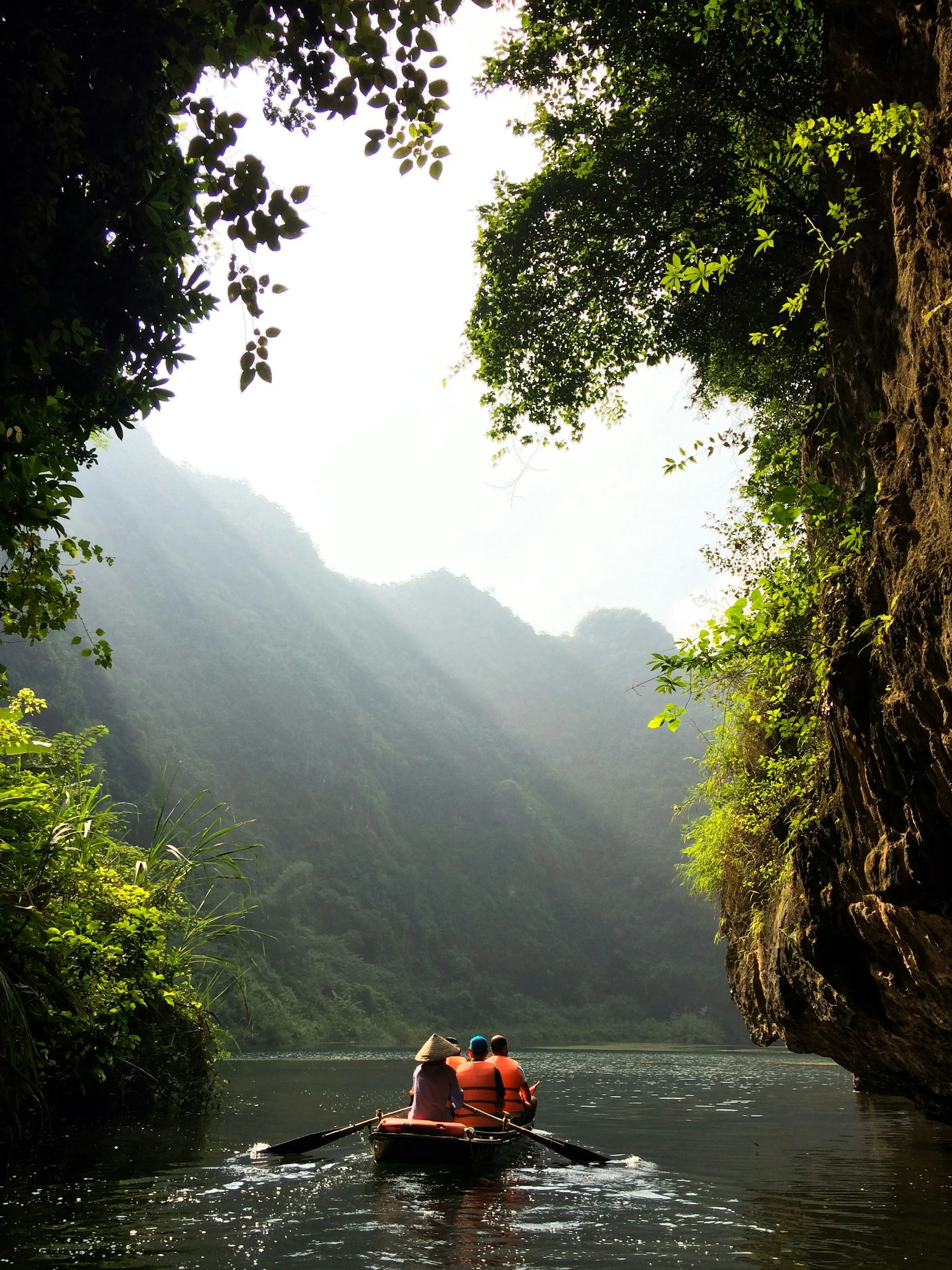
I was on a boat. The karst towers rose on both sides of me and the water was very, very still and I had the feeling — not a thought, no, something lower than a thought — that I was passing through something that had been waiting. Not for me specifically. I’m not that important. Just waiting without impatience, without any particular investment in who arrives.
Here is what I know about limestone that I did not know on the boat.
It is made of the dead. Ancient marine organisms (shells, coral, bones) compressed over 240 millions of years into ground. What looks like rock is remains. What feels like permanence is accumulated absence. I was sitting in a boat feeling the pull of something that was, at its most essential, a record of everything that did not survive.
And the water that dissolves it — the water that has been patiently hollowing the towers I found so beautiful — that water is just rain. Ordinary rain that absorbed the sky's carbon dioxide on the way down and arrived slightly acid, slightly changed, ready to begin. It finds the crack that was always there and enters and the chemistry begins and it doesn't stop. It just doesn't stop.
The towers that were rendering me speechless, were riddled underneath with caves, with passages, with rivers I couldn't see moving through the dark interior of what looked from the outside like solid, indifferent rock. I think about that a lot. The not seeing, until I saw.
There were two moments, maybe three, where the boat passed directly through it. A grotto first, the cave mouth opening at the waterline like a slim line, and then a karst arch, the limestone ceiling low and close overhead, the world narrowing to just that passage. Just rock and water and the dark between them. You had to duck. Everyone on the boat went quiet without being asked to.
I don't know how long it takes to pass through a karst arch. Not long. A couple of minutes at best. But there is something that happens to time inside that passage. The light disappears and then, distantly, reappears on the other side, and in between there is only the sound of the water and the smell of the rock and the very specific feeling of being inside something that formed without you, that has been forming since long before you, and will continue long after. You are not the point. The arch was not made for you. You are just a small warm thing passing through a hollow that water made over centuries, in the dark, without anyone watching.
Nothing looks like anything is happening. The surface holds. The surface looks fine. And underneath, for centuries sometimes, the hollowing continues. Invisible. Patient. Until the day the surface can no longer hold what it was never actually holding and the collapse comes. Sudden. Total.
But here is what undoes me when I think about it.
The collapse was never sudden. The collapse was always coming. Every day of apparent solidity was also a day of hollowing. The ground just didn't show it. The ground kept its face. It is similar to the iceberg, which has earned its cliché. Ninety percent below the surface. What you see is the smallest true part of the thing. Or the river stone, which looks smooth, complete, finished. It looks like it has always been that shape. But the shape is the record of everything the water did to it. Every tumble, every abrasion, every year of current. The smoothness is not the absence of violence. It is the accumulated result of it. Or chalk cliffs (limestone's cousin) porous, riddled with the remains of ancient organisms, dissolving slowly in rain. The cliff face that looks permanent is retreating. Has always been retreating. Just slowly enough that you don't see it in a single lifetime.
None of it was ever as solid as it looked. The surface is always the last to know.
I'm still not sure I know how to write about Ninh Binh.
But I think this is where I have to start. That I remember sitting on that boat (I think it lasted about 3 hours), completely losing track of time, oblivious to the weather, enchanted by the karst towers even as I watched their razored pinnacles threatening the sky, their cave mouths open like something that had forgotten to close, the ceilings dripping, the breakdown slabs on the cave floors where the rock had already given way, the walls pitted and eaten and scarred. All of it beautiful, all of it in the process of falling. I fell in love with it.
And in some sad way, I convinced myself that it loved me too. That the towers felt the jolt of recognition when I appeared. The dead marine felt seen by me. That I was not just another small warm thing passing through a hollow that had been forming since long before me. That the water dripping from the cave ceiling was dripping for something. That the darkness inside the karst arch held its breath when my boat entered.
I know that's not how limestone works.
I'm not sure knowing helped.
And yet I keep learning the geology. I keep reading about limestone. I keep wanting to understand the chemistry of how something that looks solid becomes hollow. As if understanding the process will make me less surprised by the collapse. As if knowing the name of what is happening inside the rock will make me hurt less about it being unable to reciprocate my feelings.
I think they did hold their breath.
