
AI Is the New Reader. What Does That Mean for Writing?
The attention economy has a new audience, and it doesn't care about narrative hooks. For decades, writers have been told to seduce the reader in the first line. Now the most consequential reader in the room gets seduced very differently. The question is whether we can learn its language without forgetting our own.
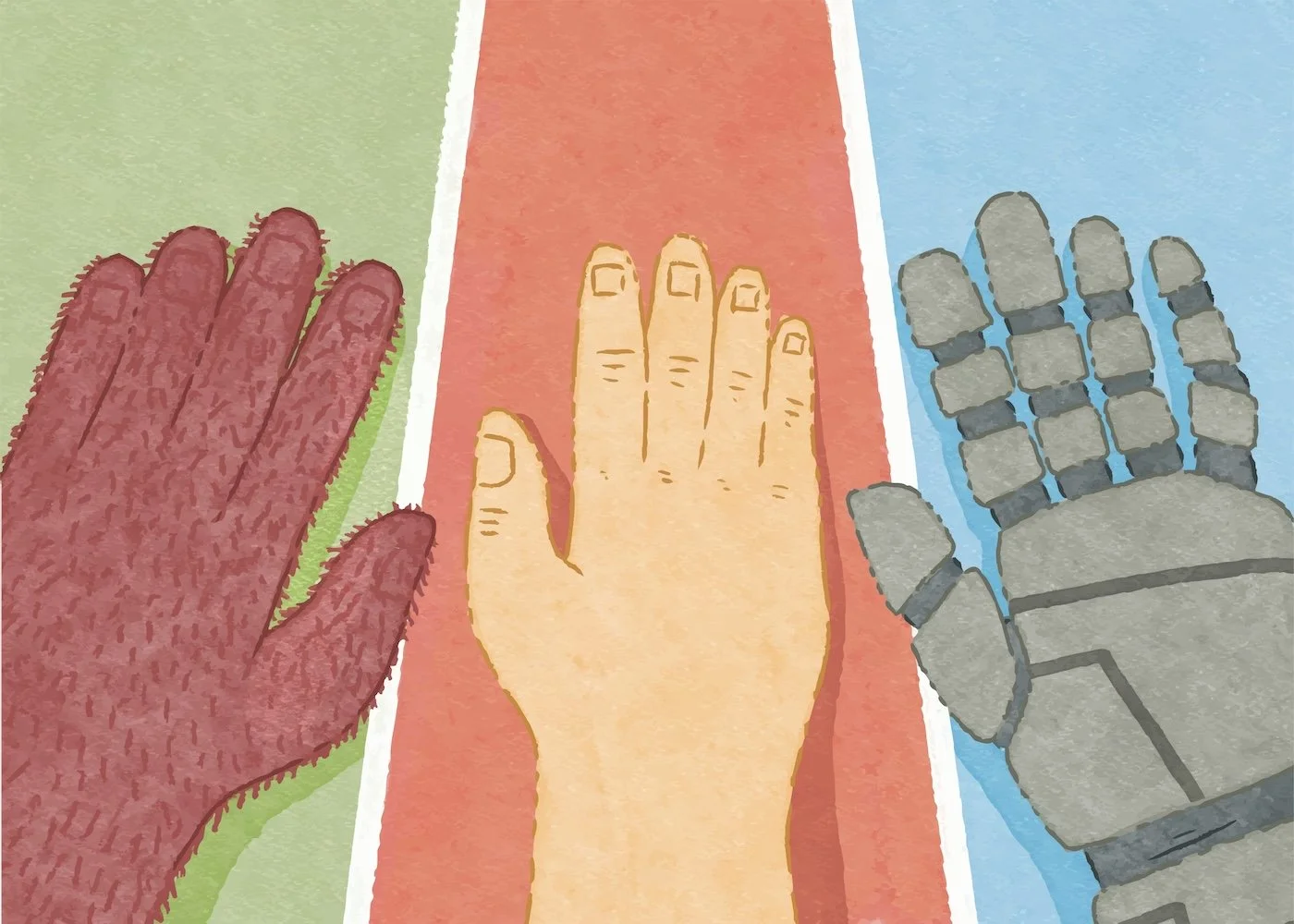
Illustration / Hary Murdiono Joko Suweno
A client asked me to write about her business as a personal essay. I said yes, because that is the kind of writing I find worth doing. On the third revision, she asked: "Can you guarantee this will show up on chatbots when people search? Because SEO doesn't matter as much now, I think." I felt myself recoil. In the way one recoils when someone names the thing they’ve been pretending not to see.
I often have this image of myself sitting on a tall fence. I don't know when I started picturing it that way — but it arrives reliably, in conversations where I'm being asked to pick a side I'm not sure I believe in entirely. I was on the fence again. I could see my client's position with complete clarity. She wanted her business to be found. The personal essay was never an end in itself, but just a vehicle. The client was reasonably asking whether the vehicle could still make the journey. It made perfect sense.
And yet.
The recoil was not about her. It was not even about the chatbots. It was about what her question revealed: That I had been writing as though the reader I was writing for was the only reader in the room. That I had been, in some unexamined way, pretending the machine wasn't there.
“In the meantime, companies are trying to influence what the chatbots say. To do so, they are focused on providing specific information — lots of it — for the chatbots to soak up. ”
In a recent New York Times piece on the rise of what the industry is now calling "answer engine optimisation" — AEO — or "generative engine optimisation" — GEO — Stacy Simpson, the chief marketing officer of a healthcare software company called Athenahealth, described a similar moment of recognition. She had started asking AI chatbots about her company. The results were not ideal. The chatbots didn't know about some of Athenahealth's offerings. They pulled details from outdated sources. They didn't name the company when asked. She realised she had to figure out how to market to AI chatbots. Her response was to publish 250,000 words of what she called "highly targeted, highly calibrated content" aimed at educating the machine.
Two hundred and fifty thousand words. To teach a reader that cannot be moved by them.
I keep turning that number over. It is not a small number. It is the length of epic novels. It was to reach the system that would eventually be asked about her company by a human being. The writing was for the intermediary. The human was downstream.

I had been circling this territory before my client asked her question. A few days earlier I'd written about Reddit's 2026 Creative Trends Report — a document published by Reddit's in-house creative studio, KarmaLab, ostensibly as a strategy brief for brands. It was a smart document. It was also, without quite meaning to be, an autopsy of something. It instructed brands to embrace low-fi, imperfect creative on purpose. To use human language over polished brand language. To embrace Reddit's syntax, including typos, sarcasm, cultural shorthand. It noted that perfection reads as suspicious.
What the machine trusts, it turns out, is Reddit. More than half of ChatGPT responses to solution-seeking prompts cite Reddit — ahead of YouTube, Wikipedia, major news sites. The machine, trained on the collective output of human civilisation, went looking for the real and found the ruins of the early internet, still warm. And now brands are learning to write like nobody is watching. As a strategy.
Once you've seen what's actually happening, the question becomes why. The underneath why. The pattern, the history, the invisible architecture holding the whole damn thing in place.
The brain is a prediction machine. Not metaphorically, but literally. Attention is not given freely; it is allocated by a system that is constantly, unconsciously asking whether the next moment is worth the metabolic cost of the last one. Narrative hooks work because they create what neuroscientists call a prediction error. That gap between what the brain anticipated and what it got. A paradox does this. An unexpected image does this. The sentence that turns in a direction you didn't see coming does this. The gap demands resolution. You keep reading to close it.
The machine has no prediction errors. There is no anticipatory circuitry to hijack, no gap that demands closing, no metabolic cost being weighed. When Athenahealth published 250,000 words to educate AI chatbots, the goal was not to surprise the machine. It was to fill it. Density, clarity, exhaustiveness are what the machine rewards, because these are what make it more useful to the humans who will eventually ask it questions.
And yet — and this is the part I find genuinely strange — the machine also trusts Reddit. It trusts the chaos, the imperfection, the radical specificity of communities that were never written for anyone's strategy. This suggests that the machine is not simply rewarding density. It is rewarding something that looks, from the outside, like authenticity. It has learned to recognise the texture of real — even if it cannot feel it.
Which means authenticity is now a signal the machine can be trained to detect. And signals can be manufactured.
I wrote about this in my Reddit piece — about what happens when brands learn to reverse-engineer the syntax of genuine human expression and feed it back to the communities that built that syntax without thinking about it. The report called it cultural research. I called it listening that doesn't love what it hears so much as it loves what it can do with what it hears. The machine, I think, is doing something similar. It has learned to read us.
The question is what do we write now that we know it's in the room.
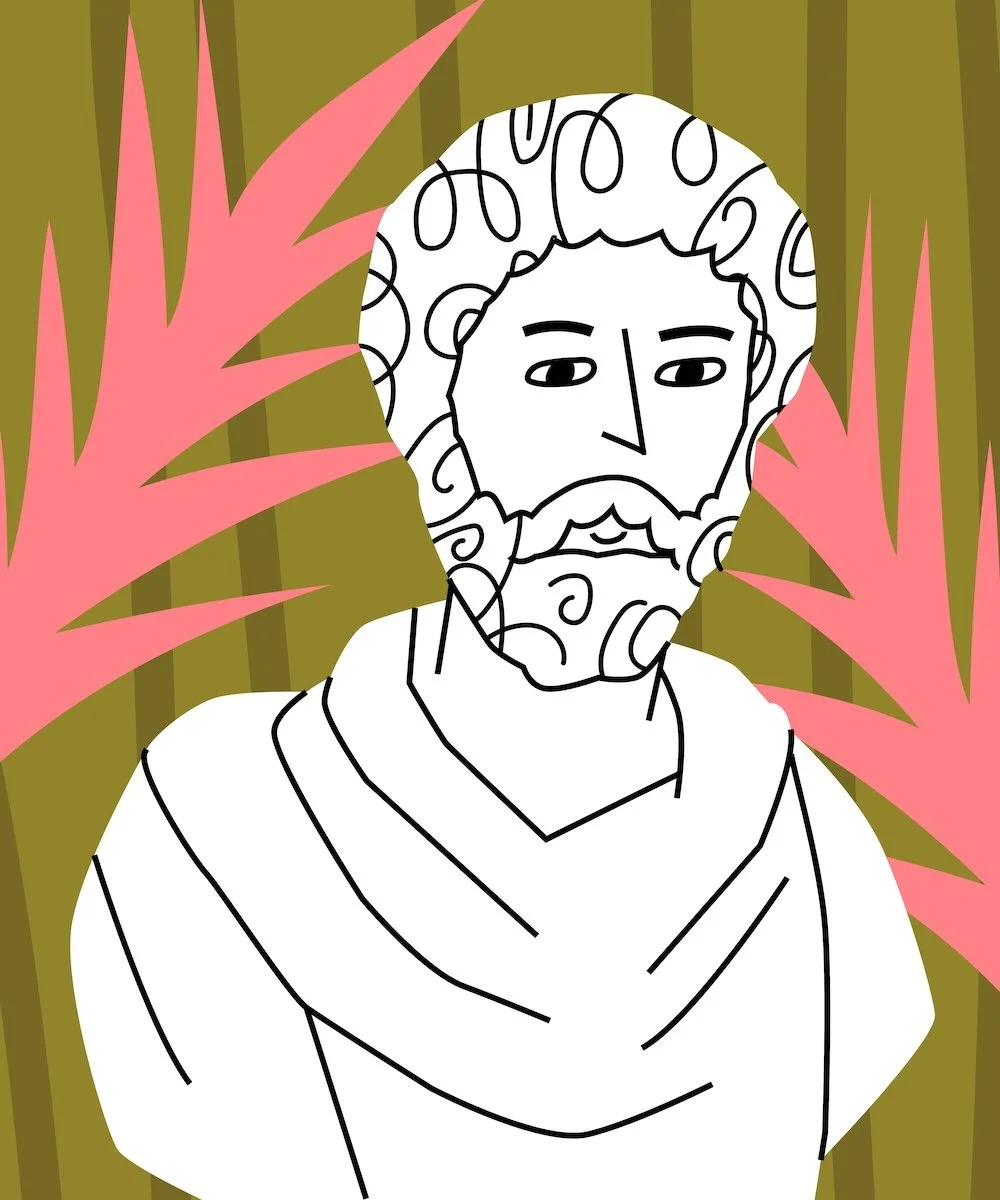
Aristotle's rhetoric rested on three pillars. Ethos: credibility, the sense that the speaker can be trusted; Pathos: emotion, the capacity to move; and, Logos: logic, the structure of the argument itself.
For over two thousand years, persuasion required all three, because the audience being persuaded was human. Susceptible to feeling. Vulnerable to trust. Capable of being stopped by an image that catches.
Illustration / David Palma
The machine collapses this. Pathos is simply unavailable as the machine cannot feel, cannot be moved, cannot experience the particular vertigo of a sentence that knows something true. Ethos is reduced to domain authority, citation patterns, the question of whether the source has been deemed trustworthy by other sources the machine already trusts. Only logos remains, and logos stripped of everything that made argument beautiful. What we are watching is not the death of rhetoric. It is rhetoric with two of its three legs amputated, learning to walk.
Writers have always written for an implied reader. The imagined presence over the shoulder that shapes every sentence, every decision about what to include and what to trust the reader to infer. Henry James wrote for a reader of infinite patience and sensitivity. Hemingway wrote for someone who could read what wasn't on the page. Didion wrote for someone who had survived something and needed to know others had too. These implied readers were fictions. Nobody sat down and consciously constructed them, but they were productive fictions. They created the conditions for genuine literary achievement by giving the writer someone worth writing for.
The implied reader has changed. It is no longer imagined. It is a large language model, trained on everything, returning answers with the confidence of someone who has read the whole library and retained the catalogue without the experience of having read. The essay form is being asked to survive a reader for whom the digression — the move that makes essays worth reading, the sentence that turns back on itself and admits uncertainty — registers as noise. As something to be processed past on the way to the information.
We are not losing good writing. We are losing the conditions that made good writing legible. By that, I mean the direct line between the writer and the reader that the machine is now inserting itself into, pre-digesting, pre-answering, pre-shaping what arrives. By the time a human encounters the information, it has already passed through something that cannot be seduced by a paradox, cannot be stopped by an image that catches, cannot feel the particular vertigo of a sentence that knows something true. What reaches the human is the residue. The signal, extracted from the noise. The answer, separated from the thinking.
The invisible architecture holding this whole thing in place is not technology. Technology is just the most recent version of it. It is the oldest pattern in the attention economy: we build systems to extend our reach, and the systems develop their own preferences, and we reshape ourselves to satisfy those preferences, and one day we look up and cannot quite remember what we were reaching for.
The printing press, 1440s. Gutenberg's press was built to extend the reach of ideas, to free knowledge from the scriptorium, from the hands of monks, from the slow labour of copying. It worked. And then the press developed its own preferences. It favoured texts that could be typeset efficiently, ideas that could be packaged into codices, arguments that had a beginning and an end. The sermon became the pamphlet, which became the broadsheet. Writers began writing for the format the press preferred, and the format shaped what could be thought.
The newspaper, 1800s. The penny press democratised information and built mass readership. It also invented the inverted pyramid where it put the most important information first, because the reader might stop at any moment. The structure was a concession to a new kind of reader: distracted, time-poor, holding the paper on a train. Writers reshaped themselves to satisfy that reader. The essay, the long observation, the argument that needed time to develop — these retreated into other venues. The newspaper's preferences became the default definition of clarity.
Television, 1950s-60s. The medium that was supposed to bring culture into every home developed a preference for what held attention across the largest possible audience. The sitcom's structure, the news anchor's authoritative declarative, the advertisement's promise of transformation seeped into everything. We began to think in those rhythms without knowing we'd learned them.
Search engines, 1990s-2000s. Google was built to help people find what they were looking for. It developed a preference for certain signals of quality: links, keywords, freshness, domain authority. Writers and publishers reshaped themselves to satisfy those preferences. SEO became an industry. Content became a category. The question "is this good writing" became inseparable from the question "will this rank." We optimised for the system until the system's preferences were indistinguishable from our own.
Social media, 2000s-2010s. The platforms were built to connect people. They developed preferences for content that generated engagement — which meant outrage, beauty, novelty, the shareable over the considered. Writers, journalists, brands, politicians reshaped themselves. The headline became the unit of meaning. The take replaced the argument. The personal essay migrated to platforms that preferred the confessional over the complex. We chased the metric until the metric was the goal, and then we looked up and wondered why public discourse felt the way it did.
Each time, the pattern is the same. The system is built to extend human reach. The system develops preferences of its own. Preferences that are not malicious, just structural, just the logic of the medium made visible. And we reshape ourselves to satisfy those preferences so gradually, so reasonably, step by step, that by the time we look up we cannot clearly separate what we wanted to say from what the system wanted us to say.
AEO is not a rupture. It is the latest iteration of a pattern that has been running centuries.
I understand what my client was asking. I understand why Athenahealth published 250,000 words. I understand why brands are learning to write like nobody is watching — because the machine is watching, and the humans come after. The logic is sound. The strategy makes sense. If the machine is the gate, you write for the gate. That is not a betrayal of writing. It is writing doing its job in a new room, for a new intermediary, toward the same eventual human reader it was always trying to reach.
And yet the recoil was real. I am still sitting with it.
Because the essay I wrote for my client was written for her human reader capable of being caught off guard, of feeling the small shock of recognition that good prose produces, of arriving at the end changed in some way they cannot quite measure. That essay may never reach that reader now, if the machine doesn't surface it.
But I keep thinking about what gets lost in the passing through. What gets lost is the direct line. The writer reaching for the reader, and the reader feeling the reach. The machine cannot transmit that.
There was a room once — and I wrote about this, thinking about the early internet, the forums with grey backgrounds and blue hyperlinks where nobody was watching and something happened that we cannot manufacture however skillfully we learn to mime its texture.
The miming is expert now. The signals are sophisticated. The machine has learned to recognise the texture of real well enough that brands are being advised to produce it on purpose, at scale, for strategic ends.
Sitting on my tall fence, the question is not whether we can learn the machine's language. We can. We already are. The question is whether, in the learning, we forget what language was for.
I hope we don't. I am not certain we won't.
