
Tanghulu at Forty
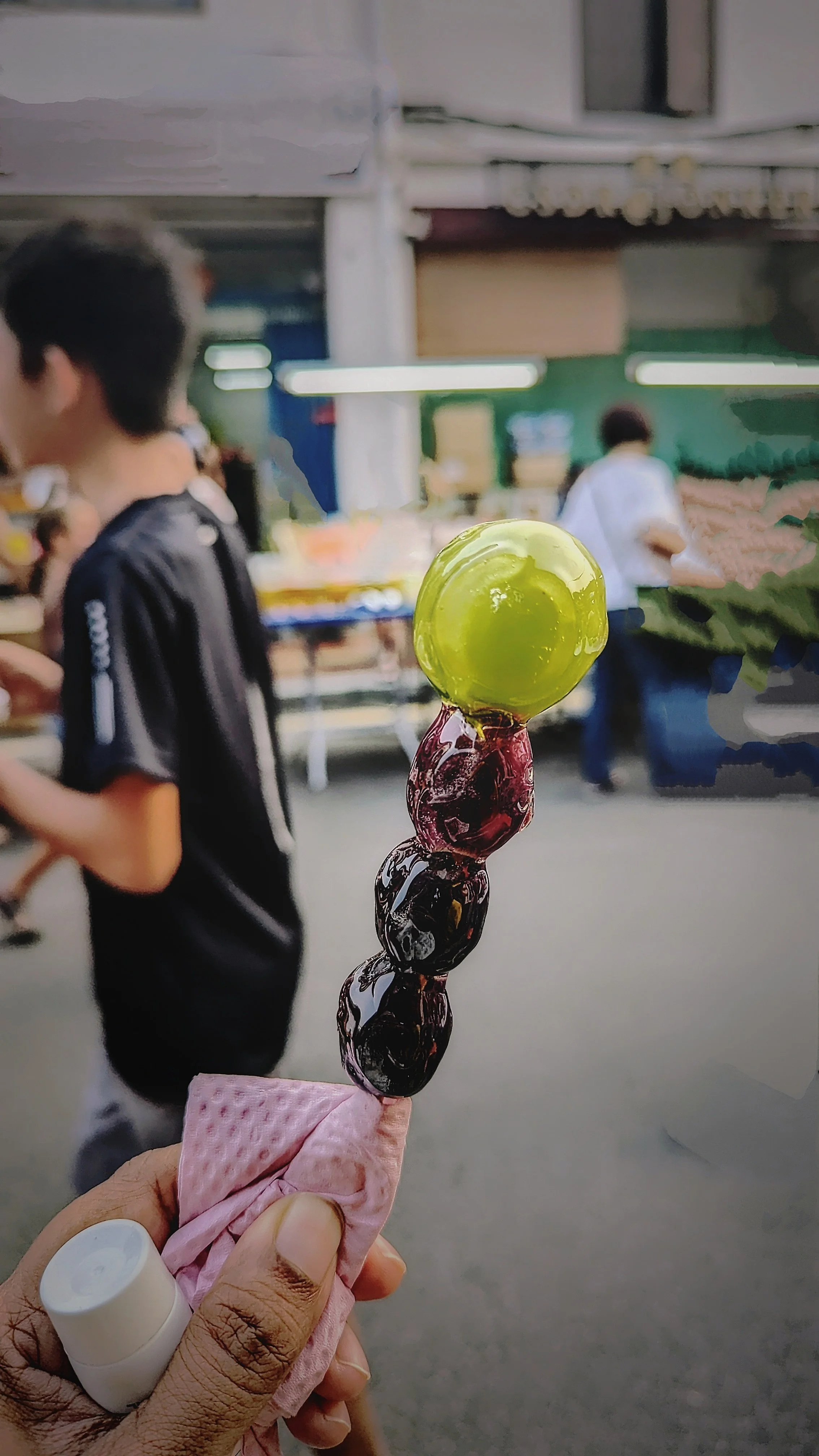
The grapes glistened under the streetlight. Coated in hardened sugar, they caught the glow like glass beads. I had never heard of tanghulu before TikTok.
The vendor hands it to me on a wooden stick and I stand there in Jonker Street holding this thing I learned about from teenagers on the internet. "Very traditional," he says. "Chinese New Year snack."
I nod, though nothing about this moment is traditional for me. Not the snack, not the festival, not even my presence in this heritage zone that exists to preserve a specific synthesis of Chinese and Malay culture that I'm adjacent to but never part of.
I'm Singaporean Indian. I've lived my entire life alongside Chinese culture. Chinese neighbours, Chinese festivals marking my calendar, Chinese food in every hawker centre, Chinese assumptions about what "Singaporean" means. But alongside is not the same as within. I've spent forty years as a particular kind of witness: intimate with something that's never been mine.
And now I'm in Melaka, in a UNESCO World Heritage Site built around Peranakan heritage, eating grapes dipped in sugar because TikTok made them beautiful and the algorithm decided I should want this.
The sugar cracks between my teeth, too sweet, and then the grape bursts - cool, familiar, nothing exotic about it at all. These are regular grapes. The kind you buy at any supermarket. Someone has simply coated them in crystallised sugar and called it traditional Chinese snack.
Which it is, apparently. Or was. Except traditionally it's made with hawthorn berries, which are sour and medicinal and grow in northern China where winters are cold enough to justify hot sugar as preservation method. Not grapes. Not in tropical Melaka where nothing about the climate or ingredients suggests this snack should exist.
But here it is. Here I am. Eating it.
I've been thinking a lot lately about what it means to witness cultures that aren't yours. Not as a tourist; I live three hours from here, but as someone whose life has been shaped by proximity without belonging.
In Singapore, this is the default condition for many of us. We share space, share festivals (sort of), share food (definitely), but we each maintain our own category. Chinese. Malay. Indian. The categories are so firmly maintained that even after three generations, we still lead with them of forms and documents. "I'm Indian" means something specific—though I’m Singaporean enough to admit I’ve no idea what.
My son learned about tanghulu the same way I did: from the internet. For him, it's not "Chinese culture" in the way that has weight and history and ancestral transmission. It's just a thing that looks cool, that his friends are also discovering via the same platforms, that no one's grandmother made but everyone's suddenly performing familiarity with.
Is that his culture? Is it mine because I'm eating it right now?
A girl ahead of me in line is taking photos. She's looks Malay, and she's photographed her tanghulu from seven different angles before she takes a bite. I counted. Seven attempts to capture the way the sugar coating catches the light, the way the red grapes look jewel-like against Jonker Street's heritage shophouses.
When she finally bites into it, she says "cantik" - beautiful - to her friend. Not "sedap" (delicious), I notice. Beautiful first. The aesthetics matter more than the taste, which makes sense because this is platform food, content food, proof-you-were-here food.
She'll post this to Instagram. Her followers will see a Malay woman eating a Chinese snack in a Peranakan heritage zone, and what story will they tell themselves about what they're seeing Multiculturalism? Heritage tourism? A generation that's post-ethnic, consuming each other's traditions freely? Or just: someone eating grapes coated in sugar because the internet said it was worth doing?
I've been reading about UNESCO's heritage designation criteria. Melaka got World Heritage status because of its "outstanding universal value" - specifically, the unique Peranakan culture that emerged here from centuries of Chinese traders marrying local Malay women, creating this specific hybrid of language, food, architecture, customs. The application often runs to hundreds of pages. Proving authenticity. Demonstrating historical significance. Committing to preservation of specific cultural markers.
I guarantee no one mentioned TikTok in those documents.
No one anticipated that global algorithms would decide what "traditional Chinese culture" means to a generation that learns history through phones. No one planned for vendors in this carefully preserved heritage zone to be selling a northern Chinese street snack that's been adapted with grapes because hawthorn berries probably wouldn’t appeal to the tourists.
But here we are. Heritage as living, breathing, adapting thing rather than museum exhibit. Which is what heritage always was, actually. We just see it happening now at algorithmic speed instead of generational time.
I finish one grape and move to the next. The sugar coating is uneven - thicker in some spots, nearly transparent in others. The vendor is still learning the technique, I can tell. Or maybe he learned it perfectly from YouTube videos but the humidity here makes the sugar behave differently than it does in Beijing winter.
I think about my mother, which surprises me.
Not because she would have known about tanghulu. Her relationship to food and tradition has always been so clear. She makes thosai the same way every other day. I wonder who taught her about the ‘right’ fermentation time, the right ratio of rice to urad dal. She makes sambar with her own spice blend, adjusted for ingredients available in Singapore but still recognisably hers.
I have no equivalent to give my son. Is he less Indian because his palate is platform-native rather than grandmother-native? Or is he just... accurate? A Singaporean kid whose culture IS this mix, this constant adjacency to everything, ownership of some things, easy familiarity with others, and the internet filling in the gaps where grandmothers used to be?
Two Chinese tourists walk past speaking Mandarin. One points at my tanghulu and says something. The other laughs. I catch only fragments but I understand the gist: they're amused or bemused to find tanghulu here. Either because it IS somehow authentic despite the grapes and the tropical setting, or because it's absurd to find a Beijing street snack in a Malaysian heritage zone being eaten by an Indian woman who learned about it from TikTok.
Both readings are probably true.
I don't speak Mandarin beyond basic pleasantries. Not my language, not my inheritance - but I've lived my whole life understanding that Singapore's version of "Chinese" is itself specific, already adapted, southern, Hokkien and Teochew and Cantonese but rarely Mandarin until recently, already different from China-Chinese in ways that matter to people who track these distinctions.
So when these tourists see tanghulu in Melaka, are they seeing their tradition traveling? Or are they seeing what I'm seeing: something that's already transformed, already adapted, already performing tradition rather than being it?
The vendor is already making another one for someone else. A young Chinese Malaysian couple, both filming. The boy holds the stick while the girl adjusts the angle. Three takes before they're satisfied.
I wonder if he's Peranakan. If his family has been in Melaka for generations, running shops on this street, adapting to every wave of tourism and commerce and cultural performance. Or if he's newer to this, just someone who saw a business opportunity and learned a skill from the internet like everyone else.
Does it matter?
Heritage tourism requires vendors. Someone has to sell the postcards, the batik sarongs, the things labeled "traditional crafts" that come from factories elsewhere. Because nostalgia doesn't pay bills.
The vendor selling tanghulu is doing what vendors have always done: adapting to demand, learning what sells, calling it traditional because traditional sells. I don't mean this cynically. I mean: this is how culture actually works.
Peranakan culture itself was adaptation. Chinese traders marrying Malay women, creating new language (Baba Malay), new food (combining Chinese ingredients with Malay spices), new customs that were neither fully Chinese nor fully Malay but something specific to this place, this history. They were doing exactly what this tanghulu vendor is doing: taking something from elsewhere and making it work here, now, for the economy they're actually living in.
So who am I to say what's authentic? I'm standing here eating grapes on a stick, in a heritage zone that commemorates one kind of hybridity while I'm witnessing another kind emerge in real-time, and I belong to none of it except as observer.
Which is, actually, what I've always been. It feels like my nationality trained me for this. I can join in with the Chinese Singaporean families on my street celebrate Chinese New Year without needing to claim it as my tradition. I can appreciate the care they take with ang pows, with reunion dinners, with the specific rituals that mark the calendar, without performing false familiarity. I can see it clearly precisely because it's not mine. And maybe that clarity. Witness attention without possession is its own kind of knowledge.
A boy passes me filming himself eating tanghulu in front of the Cheng Hoon Teng temple. The oldest functioning Chinese temple in Malaysia, according to the plaque. He does three takes, adjusting his expression each time. On the third take he gets it right: the temple's ornate roof framing him perfectly, the tanghulu catching golden light, his face suggesting he's discovered something wonderful.
The grapes are finished now. I'm left holding a sticky wooden stick, my fingers tacky with dissolved sugar.
I didn't photograph it much. I rarely do. It's one of my peculiarities, this resistance to documenting experiences as they happen. I tell myself it's about staying present, about not mediating everything through a lens. But maybe it's also about not claiming. If I don't post it, I don't have to perform belonging. I don't have to caption it with some story about what this means culturally, what I'm discovering, what tradition I'm participating in. I can just witness it. Pay attention. Notice what I notice. Except I am going to write about it. This essay is its own kind of claim to meaning-making. I'm just using different platforms, different aesthetics of authenticity, different ways of saying "I was here and this mattered."
Back home, I look up hawthorn berries. They grow in northern China, cold climates, nothing like tropical Malaysia. They're used in traditional Chinese medicine - aiding digestion, promoting circulation. There's a history of Beijing street vendors selling tanghulu in winter, the sugar coating preserving the fruit, making sour berries palatable to children.
So it IS traditional. Just not here. Not with grapes. Not in this climate.
The algorithm shows me another tanghulu video. Seoul this time. Then Bangkok. Then somewhere I don't recognise - maybe Manila, maybe Jakarta. Same glossy aesthetic, same performance of eating-as-discovery, same caption claiming tradition.
I watch instead of scrolling past. A pattern is emerging: we're all eating each other's nostalgia now. The internet has made every regional tradition available to everyone, which means we can all perform familiarity with things we have no ancestral claim to. Is this just what culture has always done? Travel, transform, get claimed by new people in new contexts, change meaning as it moves?
The Peranakan families who created the heritage UNESCO is protecting; they were doing exactly this. Taking Chinese traditions and adapting them to Malay context. Taking local ingredients and incorporating them into Chinese cooking. Creating something new that was neither original nor copy but synthesis. They were the algorithm of their era, just slower, more localised, less documented.
What I'm resisting, I think, isn't the tanghulu itself or its viral spread. I'm resisting the speed. The way culture used to take generations to travel and now takes seconds.
Or maybe I'm resisting something deeper. Now everything is everyone's. Every tradition is Google-able, replicable, consumable. The specific texture of your grandmother's recipe can be flattened into listicle, Instagram tutorial, viral trend. My son will grow up in a world where culture is platform-native. Where he can learn to make thosai from YouTube, tanghulu from TikTok, pasta from Italian grandmothers who've monetised their nostalgia. Where "traditional" means whatever the algorithm surfaces, and "authentic" means well-filmed.
Is that loss? Or is that just... accurate? The world as it actually is now, not as we wish it to be?
The next morning I walk past a café that's added tanghulu to their menu. Not fruit on sticks - tanghulu-inspired drinks. Grape soda with popping boba and edible glitter, served in plastic cups designed to photograph well.
Tanghulu aesthetics.
I think about photographing it, then don't.
I keep thinking about those grapes. How they're not traditional at all - hawthorn berries are traditional. How that substitution makes the whole thing more honest, actually. Because this is what culture IS: constant substitution, adaptation, making-do with what you have, calling it traditional because you need it to mean something.
I ate grapes on a stick in Melaka. I learned about it from TikTok. It has nothing to do with my grandmother, my mother, my inheritance.
But I can't stop thinking about it.
About what it means to consume freely across cultural boundaries while still maintaining them. About what gets lost and what gets created when tradition travels at algorithm speed. Not authentic transmission from grandmother to grandchild. Just endless, restless adaptation. Everyone borrowing, everyone claiming, everyone calling something traditional that they learned from the internet last month. And somehow, against all odds, some of it sticks. Some of it becomes real. Some of it turns into the thing grandmothers will teach grandchildren forty years from now.
Culture doesn't care about our categories. It just moves, changes, adapts, survives.
I'm still thinking about it. Still paying attention to what happens when you're always outside, always watching, never quite claiming but never quite separate either.
