
The Last Thousand Feet
The approach into Da Nang settles you over a broad coastal plain with unhurried rivers wandering through it. This is the country's narrow waist, where the Annamites crowd the coast closely. From the air you can see the whole arrangement at once, and what holds me over this plain, every time, is what the villages decline to do. They decline to gather. There is none of the huddled nucleus of the European village, houses drawn in around a church like heat around a fire; here the houses go in ribbons instead — single file along the roads and the riverbanks, each one shoulder to its neighbour's shoulder, with the paddy lying open and green at their backs.
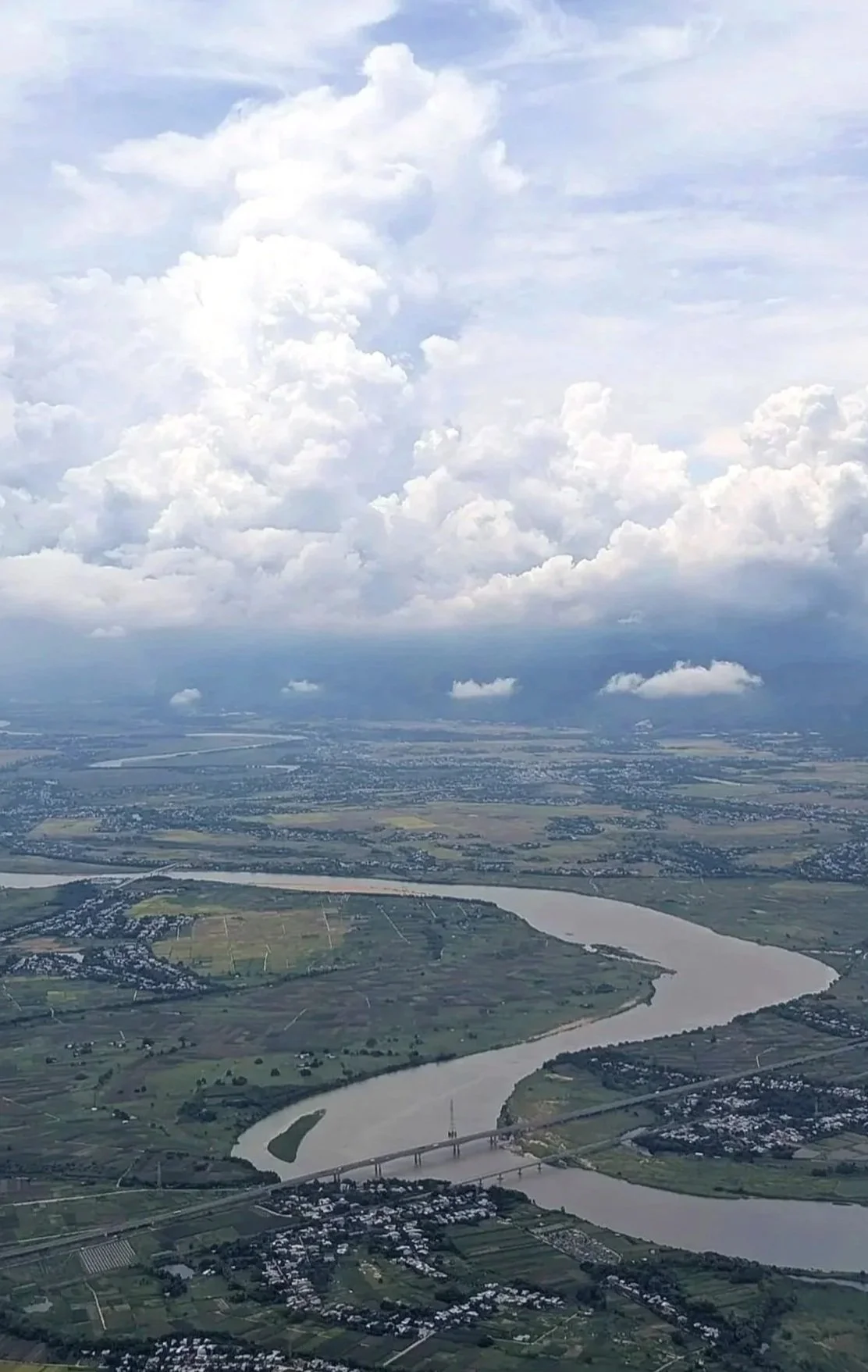
The river below is wide and silty, the brown of tea taken with too much milk. A long, low bridge crosses it — one telecom mast standing up from the far bank like a pin in a map — and I watch a truck take the whole span in the time it takes the river to do nothing at all. Over the mountains the monsoon has been building all afternoon, cumulus stacked on cumulus. The clouds making a whiter, taller, entirely ungoverned second landscape above the first; with its own ranges and its own coastline; it occurs to me that I am between two countries, and only one of them will let me land.
Then the seatbelt sign, and the plain coming up fast, the ribbons thickening into streets, the texture resolving into roofs, one roof, a courtyard, washing on a line. The overview surrenders in stages. Somewhere in the last thousand feet the pattern doesn't dissolve, but I lose the distance required to see it. The villages are still ribbons. The river is still gathering them into its curves. The bridge still stitches one bank to the other. But my eyes have become too close to hold them together. By the time the wheels touch, I have lost the entire pattern and gained the ground.
I wonder how many things in ordinary life are like this — visible only from a distance.
A relationship has a pattern the way a coastline does — which is to say, a shape that depends entirely on how far away you are standing. There is this cove, the argument about the dishes, or the other one about the in-laws; each one so local, so completely itself, that it would be strange to think of it as part of anything. The argument about your spending habits does not resemble the argument about the tone you took on the phone. They occur months apart, dressed differently, and you meet each one as a stranger. The costume is always convincing because you are always close enough to see only the fabric. Then, one day, a friend, meaning no harm, reflects your last three arguments back to you, and the shoreline surfaces. She has stood where you cannot stand, and read the shape that was there all along.
Your own life behaves the same way, only on a slower clock, which makes it the harder coastline to see. At least an argument ends, and lets you step back from it. A decade doesn't end so much as change its name. Nobody can see the one they are standing in. From inside, a decade is a sequence of hours, and days, and weeks, and years. There isn’t a shape when each decision arrives alone and looks reasonable, in the way each cove looks like the whole of the sea. You do not experience yourself as choosing the same city in different countries, the same person under different names. You experience yourself as choosing this city, for excellent reasons; this person, who resembles no one. The resemblance is a fact about your life that your life withholds from you for as long as you are in it.
Which may be all that memoir is. Not remembering — anyone can remember; memory is just the coves again. Memoir is what becomes possible when a writer has finally lost enough proximity to her own terrain: she goes back over the ground she wandered for years and finds that the wandering drained somewhere all along, that every apparently separate river ran to the same sea. What she took, at the time, for weather — this storm, that drought, each one with its own sky and its own excuses — turns out, from up here, to have been climate. The memoirist's real discovery is rarely an event. It is a prevailing wind.
There is a ledger in all this. One feels it, though no one shows it to one. It hangs in no office and bears no seal, yet, willing or not, knowing or not, everyone alive is paying, all the time; and to stand inside a thing, to really stand inside it, is to know it as the ribbon village knows its road — not as a line on any map, not as a shape at all, but intimately, urgently, one house at a time. The village is not deprived of the pattern it makes. Deprivation is the wrong idea entirely; considering that no clerk ever refused you the shape of your own life. It is only that knowing has a location, and you were living at yours. Up close, the currency is the courtyard, the threshold, and you spent it there because that is the only place it spends.
And this is the part the ledger won't simplify: however long you stare at it, neither knowledge redeems the other. The friend who saw your three arguments cannot feel any of them. The memoirist who finally reads her watershed can no longer drink from it. Which is, perhaps, why we keep pressing our faces to aeroplane windows. It is not to escape the ground, but to visit, briefly and at terrific speed, the only bank where our lives are legible. Knowing the visit ends, knowing the wheels come down, knowing that the moment they touch we will be rich again in the one currency that buys no distance at all.
