
Fremantle: The Chart and Map Shop
THINKING OUT LOUD: We make maps because we cannot bear to move through a world we cannot hold in mind. A map gives us somewhere to stand and a way to go on. But in making the world small enough to navigate, we decide which parts of it will be visible.
I HAVEN’T RESOLVED: We cannot stop making maps, and we cannot make one that is innocent. How do I take responsibility for a way of seeing that I need in order to move through the world, knowing that someone else may have to live with what I left out?
It was not called Atlas, or Navigation World, or Meridian, or anything with a sextant in the logo. Nobody had hired a consultancy to spend six weeks and a five-figure sum arriving at the word "Wayfinder." It was called the Chart and Map Shop, which is not a name at all, really, but a description that got laminated. Which reminded me of the sort of naming that used to be the whole of commerce, back when a fishmonger was called the fishmonger and the sign painter, presumably, billed by the letter and encouraged restraint. There is an entire vanished philosophy in it.
A shop that describes itself is perhaps making you a small, old-fashioned promise: that the distance between the sign and the shelves is zero, that nothing behind the glass will surprise you, that the proprietor considers your time too valuable to spend decoding him. Somewhere in the past few decades, retail reversed the polarity where the name became the mystery and the merchandise became the afterthought, and we all learned to walk into places called Husk or Alba or Field Theory not knowing whether we'd emerge with a sourdough loaf or a linen jumpsuit. The Chart and Map Shop declined the entire era. You knew what was in there from thirty feet. Charts. Maps. The shop.
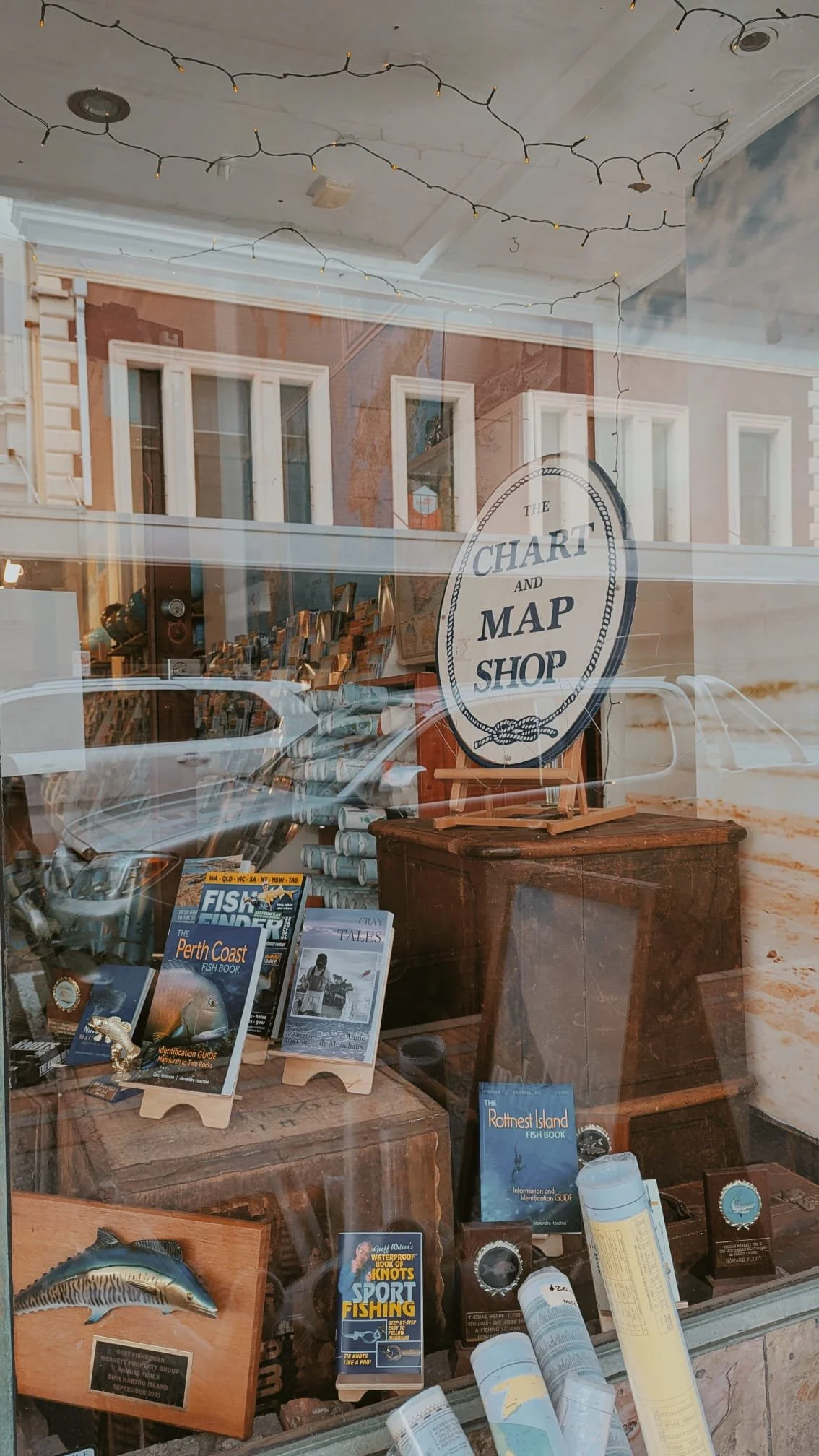
I stopped in front of it one late morning in Fremantle, walking with my son, who was a few steps ahead of me and, being a teenager, saw no reason to stop for a window full of rolled paper. I had no obvious claim on the place, either. I don't sail. I don't fish. I don't even drive. And yet I love maps — or a certain caste of map, anyway: the free ones, the tourist maps stacked at park entrances and information counters, creased into eighths by a thousand previous hands. I take one whether I need it or not, and I usually don't need it, and I take it anyway, which is probably the purest form of love a piece of municipal printing can hope for. This can only mean that this shop, by rights, should have felt like mine. Instead, it bothered me — bothered me the way a word you can't quite place bothers you, sitting just past the reach of the tongue — and I stood at the glass a good deal, doing a kind of arithmetic. Because these were not my maps. Mine are free, disposable, designed to be abandoned on a bench. These were rolled and priced and handled like instruments in an age that has supposedly filed paper navigation somewhere between the telegram and the phrenology bust. And yet here was a whole shop, rent and lighting and somebody's livelihood, wagered on the proposition that someone, still, needed to know where the water gets shallow.
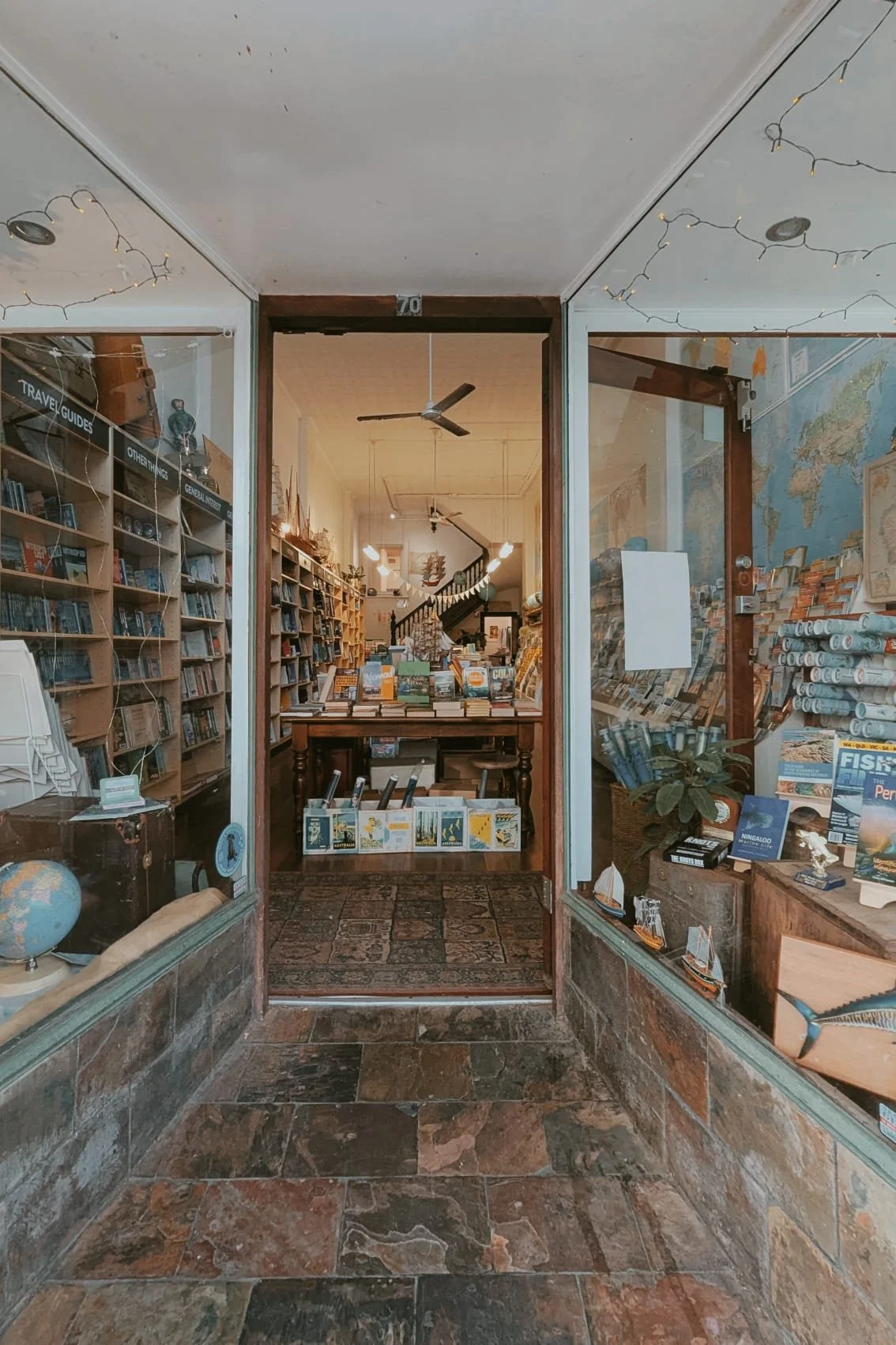
Inside, the shop declined to be poignant. I had walked in braced for the usual melancholy of the outlived business, but there were no yellowing posters urging anyone to Discover the World, no antique sextant marooned under glass with a typed card explaining what a sextant was, no brass, no rope, none of the driftwood theatre by which a dying trade converts itself into an exhibit of its own past. So very often, redundancy, handled correctly, is a retail strategy. In the way the barbershop goes Edwardian, or the pharmacy keeps the apothecary jars; but this shop wanted no part of the arrangement. Nothing in it was performing pastness.
It was a weekday, and it was winter, and Fremantle had put away its crowds; the shop held nobody but us and whoever was behind the counter. Which was a problem, because I discovered, standing among the cylinders, that I hadn't really come to see the shop at all. I had come to see the shop being used. I had questions for the customers, an unreasonable number of questions for a woman who had wandered off the footpath with no boat and no errand. Who comes here? How do they move? Do they drift the way people drift in bookstores, or do they arrive already holding a chart number the way other people hold a prescription? What do they touch first? What do the conversations sound like? Are they conversations at all, or consultations, one party describing a stretch of water and the other party frowning usefully? I couldn't check any of it. The customers were somewhere warm, doing whatever chart-buyers do in July, and I was left to speculate, which is watching's needier cousin.
So I did the only fieldwork available. I asked the shop what it belongs to. And listened.
The first answer is easy. Navigation. But navigation doesn't stand alone for long; pull on it and up comes measurement, and behind measurement comes empire, and behind empire come trade, and science, and the military, and the schoolroom, and the whole apparatus of publishing that turns soundings into stock. Keep pulling and you arrive somewhere stranger. The shop belongs to the institution of representation itself. It belongs to the ancient project of getting the world down onto a surface small enough for a mind to hold. At which point I realise I am no longer describing a shop; but perhaps observing history.
And the history goes something like this: nearly everything we have invented for finding our way — the map, obviously, but also the clock, the calendar, the archive, the library, and money, which is a map of something as unphotographable as trust — exists because the questions that matter most exceed the capacity of any single mind, and have always required equipment. “Where am I?” “What is around me?” “What happened before?” “What comes next?” No individual head can hold the answers, so we build objects that hold them for us, and hand the objects down, and correct them, and argue over them, and occasionally go to war about them. You could, if you were feeling grand, define civilisation as a succession of increasingly sophisticated orientation technologies. I felt grand for about a minute, standing in the empty shop. Then I noticed the sentence was too large to steer, and put it down, and picked up something smaller.
The smaller thing was my phone.
Here is what a phone does. You ask, in effect, how do I get there, and the system takes the question away from you. It chooses the route, recalculates when you stray, and estimates your arrival to the minute. It also hides most of the surrounding geography, because the surrounding geography is irrelevant to the task, and the task is all the system knows. This is not navigation so much as the outsourcing of it; where you have delegated the entire cognitive act, and what you receive back is not knowledge but instructions. Turn left in two hundred metres. You comply. You arrive. At no point did you know where you were.
A paper map asks different questions, and makes you do the asking. Where am I, actually? Which way is north? What is on the other side of this hill, and why does the river bend here, and how far is that, really, when the scale says one centimetre to the kilometre and your legs say otherwise? A map gives you a landscape and a problem, and the route is something you have to build, in your head, out of judgment. Psychologists have a name for what forms during this labour — a cognitive map, an internal model of space — and research has found that people who navigate by turn-by-turn instruction tend to form weaker ones than people who navigate by the shape of the land. A tendency, not a law. But it points at something the two technologies do not share, which is where the thinking happens. And that is that the phone performs the orientation; the paper asks you to perform it.
You can see the difference most clearly in the experience of being lost, which each technology has redesigned in its own image. With the phone, being lost is a malfunction, and often, just a brief one. The dots waver, the voice says recalculating, and in most instances, the uncertainty is resolved. With a paper map, being lost is information. That road isn't where I expected. The station should be east of me. If the river is here, then I must actually be — and now you are doing something no instruction can do for you: comparing the world against its representation, holding both in mind, reasoning your way across the gap between them.
Which is, I think, the real answer to the question I couldn't ask the empty shop. Who comes here? Not people buying navigation. Navigation is free now, and better, and lives in everyone's pocket. The people who come here are buying the burden back. A chart leaves the responsibility for the route with you: your reading of the soundings, your judgment about the bar at the harbour mouth, your mistake if it comes to that. The phone carries the responsibility on your behalf, and like most things carried on your behalf, it does not return easily. What the shop was selling was the older arrangement in which finding your way was your own work, your own risk, your own act of mind.
For a long time I thought the deepest thing you could say about a map was that it forgets. Every map is an act of forgetting: to draw one road is to erase another, to enlarge one city is to shrink its neighbour, and nothing appears on the sheet without something else disappearing from it. This is true, and it is not quite the point. The forgetting is the mechanism, yes — but the point is what the mechanism serves.
Every map is an argument.
A map says: this matters, and this doesn't. This road exists; that track, worn by feet for longer than the road has existed, does not. This depth is worth sounding; that reef is worth a warning; this coastline deserves a name, and the name it deserves is the one we brought with us. A chart says measure this, ignore that. And once you hear a map talking this way, you begin to hear the whole family talking. Journalism says: this is today's story, out of everything that happened today. The museum says: this belongs to history. The library says: this deserves shelf-room; the archive says: this is worth remembering, and by silence, that is not. None of these are neutral acts of storage. They are editorial acts, every one — selections, performed by someone, on behalf of everyone, and the sum of the selections is most of what we are able to notice at all. Representation is not a mirror held up to the world. It is a decision about which parts of the world get to appear.
And the decisions do not stay on the paper. This is the part that stops being interesting and starts being serious: representations reorganise the thing they claim to describe. A border drawn on a map; when drawn often enough, in an office, by men who never saw the ground — becomes, in time, a border people die defending, and the deaths make the line realer than the river it ignored. A subway map changes how a whole city imagines its own body: which neighbourhoods feel near, which feel like elsewhere, which do not feel like anywhere because no line goes there. The map precedes the territory more often than we like to admit. It, disappointingly, does not describe the world so much as commission it.
I was, remember, standing in a shop full of Admiralty charts, in Fremantle, on a coastline that was surveyed before it was settled. The Swan River was sounded and drawn and carried back across an ocean, and the drawing is what persuaded a government that a colony could be put there; the ships that followed were following a representation. This is Whadjuk Noongar country, mapped for tens of thousands of years in song and story and the worn logic of walking routes — mapped, that is, in every sense except the one that arrived rolled in a cylinder, claiming the authority of measurement. Two cartographies met on this coast, and only one of them had a navy. The tubes standing in the window were the descendants of instruments, and the instruments had not been neutral.
Nothing that selects is.
I don't want to end on the empire. It would be tidy to, but tidiness is its own kind of forgetting.
What I keep returning to is that we can’t seem to stop doing this. Take away the Admiralty and the algorithm both, and humans will still reach for a stick and draw the river in the dust for the stranger. We chart economies, illnesses, migrations, weather, galaxies, the developmental milestones of children. We map family trees and political ideologies and the progress of grief. The noun is misleading; it makes the thing sound finished. What we actually do is the verb. Not maps — mapping. Not charts — charting. Not archives — archiving; not journalism, when it is any good — witnessing. The nouns sit on shelves. The verbs are what a species does when it cannot bear not knowing where it is.
Because that is the anxiety underneath all of it, the one the shop and the phone are both answers to. It was never really about getting lost. No, because getting lost is survivable, even useful; getting lost is information. The unbearable thing is uncertainty. The unnamed street, or the day with no date on it. For as long as we have been anything at all, we have made marks.
I would like to say this is simply beautiful, the stick drawing the river in the dust, the species that cannot bear not knowing where it is. But my own conclusions won't let me. Every mark is also a claim. The river drawn in the dust is the river as one hand saw it; the chart that comforts the sailor is the chart that found the coast for the ships; the same gesture that steadies us against the dark decides whose dark counts. Mapping is not something we do because we are good. It is something we do because we are frightened, and fear has never once checked its work.
So I don't know whether to be moved or warned by that shop, and I have decided the honest answer is both. Long before the satellites, long before Mercator flattened the globe into a lie useful for sailing, before, perhaps, language itself had finished forming in our mouths, someone stood at the edge of the known and asked the question every chart in that Fremantle store is still trying to answer.
Where am I?
And almost immediately afterwards — because the first question is only ever the anchor for the second, and because whoever answers it gets to draw the map for everyone else —
Where are we going?
