
THINKING OUT LOUD: We like to imagine identity as something intimate and knowable: memory, experience, choice. But much of what makes a person is inherited before it can be examined. Family gives us ideas before explanations, loyalties before reasons, sounds before language. We receive histories without having lived them. So perhaps the human condition is not simply that we belong somewhere. It is that we are continually trying to make a coherent self from inheritances we did not consent to and experiences we cannot fully recover.
I HAVEN’T RESOLVED: How much of who I am is something I inherited, how much is something I made, and does the distinction matter if I cannot separate them anymore?
I read Missy while travelling through Western Malaysia. Every night, I curled up in various hotel beds with her — Raghav Rao's orphan turned American, her secrets folded beneath decades of reinvention; and found something I hadn't known I was looking for.
I am third-generation Singaporean Indian, which means India is something I carry without quite knowing how to hold. It is more like a word I know how to pronounce but not what it means in my mouth. Missy was the first book that reached into that silence and lingered just long enough.
There is something I will not forget about reading it this way: foreign city, foreign bed, the humid dark outside the window. Feeling, for the first time, recognised by a book, and not entirely sure what to do with that.
Perhaps it is that she too is a woman who has learned to inhabit borrowed spaces and call them home. She too carries a country inside her that she can neither return to nor fully leave behind.
The story follows Savi. Orphaned in Madras, Savi fled to America after a single catastrophic night, reinvented over decades into Missy: businesswoman, community pillar, mother. Rao's real gift is not the plot, though the plot holds. It is the way he renders a life. The domestic warmth, the visual texture of both Madras and Chicago through prose alone, earns its emotional weight.
But what kept its hold over me was something harder to name. Savi does not choose America out of aspiration. She chooses it out of survival. And the question the novel circles without quite stating is whether a self built in exile is a real self at all, or always, at some level, a performance waiting to be found out. Forty years on, when Varun arrives and the past stirs, that question stops being philosophical. It becomes the whole story.
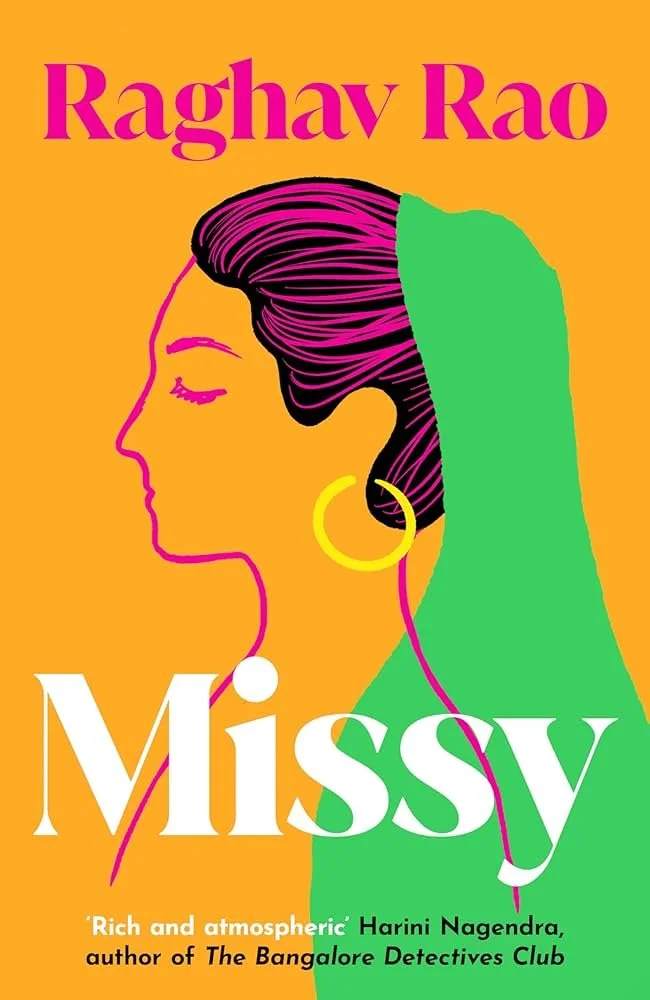
I did not pick up Missy expecting to be found by it. I picked it up the way you pick up anything for a holiday: for escape, for pleasure, for the hours between dinner and sleep. I had noted the Indian setting, the immigrant arc, the blurbs. I thought I knew what kind of book it would be.
I did not know I was looking for a map of something I had never named.
What does it mean to be third-generation? To inherit a country the way you inherit a face. Something in the structure, in the bone, that you recognise but cannot claim? I have never lived in India. I do not speak Malayalam beyond fragments. And yet there are moments when reading Rao's descriptions of South India, of the quality of heat, of the way obligation moves through a family like weather is when something in me goes still. Not nostalgia. Something older than that. The recognition of a shape.
Rao did not write Missy for me. He wrote it out of his own navigation. But somewhere in that navigation, he charted territory I had been moving through without a map. Is this what diaspora actually is? Not grief for a place you've lost, but disorientation about a place you never had. The sensation of almost belonging to something. The frequency you catch and cannot name.
I finished the book in an Airbnb in Penang, the fan turning overhead, Malaysia dark and humid outside. I lay there not reading anything. Thinking about Savi, who built a whole life from the wreckage of one night, who called herself Missy for forty years until perhaps even she forgot the girl underneath.
