
The Interior Designer's Seventh Month
An interior designer's seventh month taught me what we're all missing: a calendar that knows when to stop.
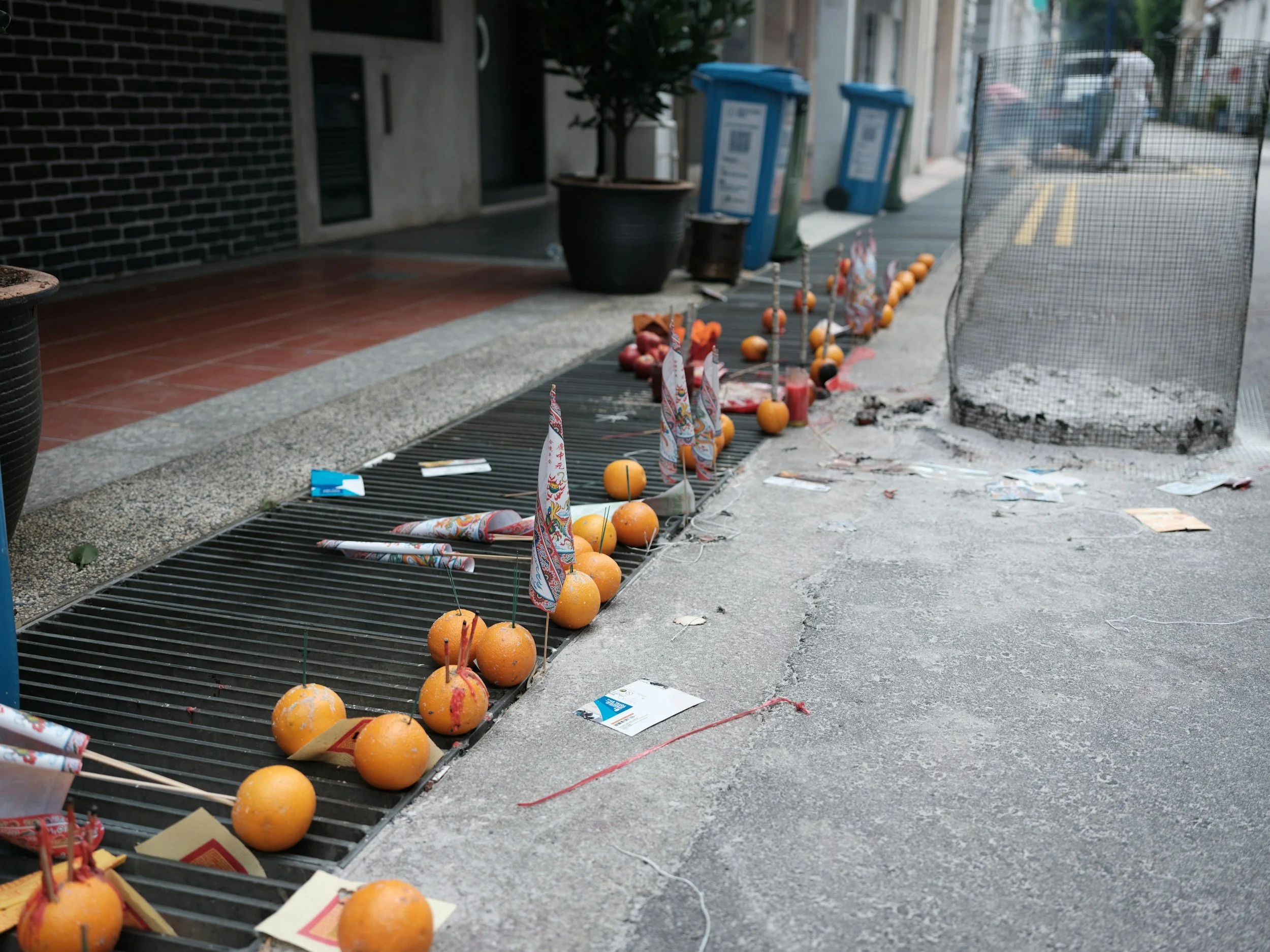
A client mentioned it in passing. Her client (an interior designer, a husband-wife duo who employed a handful of staff, a cosy business) didn't take on new renovation projects during the seventh month. Clients weren't biting anyway.
I had initially filed it somewhere between interesting and irrelevant. I wasn't in renovation. I wasn't even superstitious. And besides, multi-cultural rojak¹ Singapore is full of these inherited rhythms that everyone acknowledges and nobody fully explains. You nod, you move on.
Then the seventh month came around.
The joss paper smoke was already in the air when I started wondering. Were those in interior décor on annual leave? Designated vacation time? Perhaps like school teachers, encouraged to clear leave during off season? And the larger construction firms, I wondered if they had choped² their projects in advance, begun early enough that continuing through the ghost month was acceptable, spirits none the wiser?
But it was the small businesses I kept coming back to. The husband-wife duo. The handful of staff. The cosy business. How did they manage it? Her clients — largely Chinese, largely pantang³, largely unwilling to commit to something as permanent as hacking down walls while the hungry ghosts are roaming — make the decision for her. The culture closes the door.
But a copywriter's clients don't consult the Tong Shu before commissioning an article. A consultant's retainer doesn't pause for the seventh month. A brand strategist's inbox doesn't go quiet because of joss paper smoke. Their slow season is private. The interior designer's is collective.
A collective slow season has edges. It begins on the first day of the seventh lunar month and it ends on the last. You can mark it on the calendar. You can plan around it. You can tell your mother, your spouse, your most anxious client: not now, seventh month. And they will nod, because they already know.
A private slow season has no such edges. It bleeds. You don't know when it started, so you don't know when it will end. You can't mark it on the calendar because you don't know what to call it. And you certainly can't tell your mother. She'll just worry.
But stay with me. Here is what the slow season could be, if you (and mom) allow it.
The brain has a default mode network. A constellation of regions that activates when you aren’t focused or productive. When you are daydreaming. Wandering. Staring at the joss paper smoke without thinking about anything in particular. This is the network responsible for self-reflection, for making meaning, for the slow coalescence of disparate experiences into something you might eventually call insight. It requires idleness to function.
The interior designer's seventh month does something radical. It removes the threat. For her, this is not failure. This is the seventh month. And her nervous system, held inside a collective rhythm, knows the difference.
The psychologist Graham Wallas called it incubation. That fallow period between preparation and illumination where the unconscious does its invisible work. We have become very good at preparation. At hustling, pitching, delivering. But incubation requires something our private slow seasons rarely provide: the absence of dread. You cannot incubate when you are catastrophising. The two cannot occupy the same nervous system at the same time.
John Keats had a name for the capacity to remain inside uncertainty without frantically reaching for resolution. He called it negative capability. The ability to be in doubts and mysteries without an irritable grasping after fact and reason. It is, by most accounts, very difficult to cultivate. And nearly impossible to sustain when the rent is due.
But the interior designer doesn't have to cultivate it. The seventh month cultivates it for her. For one lunar month, the not-knowing is structural. The uncertainty has a address. And because it has an address, she can live in it without losing herself.
Which brings me to the five-foot way.
If you've spent any time in Singapore's older shophouse districts (the likes of Tiong Bahru, Joo Chiat, Ann Siang Hill, etc) you'll know it. The covered corridor that runs along the front of each shophouse, set back from the street, sheltered from the rain and sun. Neither fully inside the shop nor fully outside on the street. A threshold space. Designed with the practical intention that pedestrians always have covered passage. But what it became, was a space for living that was neither one thing nor the other. It became where the hawker set up his cart. Where the old men played chess. Where children did homework and neighbours argued and business happened without anyone having to commit to being fully open or fully closed.
The slow season is your five-foot way. Neither the full activity of peak business nor the full stop of shutdown. A threshold. And like the five-foot way, it has a function. The interior designer knows this, even if she's never put it in these words. She lives in the five-foot way for one month every year. The culture built it for her. You're still standing in the rain, wondering why there's no shelter.
Philosopher Martin Heidegger had a word for what the interior designer does without knowing she's doing it. Gelassenheit. Usually translated as releasement. Or letting be. Not passivity. Not giving up. Something more precise than either. The deliberate suspension of the will to force outcomes. A different mode of being in the world that stops pushing and allows instead.
We are, most of us, very bad at this. Particularly those of us who left the safety of a salary to build something of our own. The decision to go out alone is itself an act of will. Of forcing. Of insisting that the thing you want to build is worth building, and that you are the one to build it. That will is not wrong. It is, in fact, what got you here. But Heidegger's point (and it is an uncomfortable one) is that the will, left unchecked, becomes its own obstacle. That there are things which cannot be grasped through effort alone. Which only arrive in the space effort vacates.
The Tong Shu understood this long before Heidegger put a German word to it. The Chinese almanac is, at its core, an ancient operating system for timing human activity against something larger than human ambition. It designates not only auspicious days to begin, to commit, to expand; but inauspicious ones. Days when the wise do not force. Months when the culture itself says: not now.
The solo business owner without the language or enforced ‘superstitions’ for necessary contraction is left with an indifferent, turning pages regardless. So she pitches clients who haven't asked. Refreshes the inbox. Starts a newsletter she won't finish. She redesign the website for the third time this year and calls it strategy. Behavioural economists call it loss aversion. The mere possibility of losing momentum, clients, relevance, is enough to send us into a frenzy of activity that looks like productivity and feels like drowning.
I wrote about this once, from a different angle. About my adult gap year, and about how the people who most need to stop are the least able to give themselves permission to. About how we have no generous vocabulary for pauses in adult life. We call them sabbaticals if we're lucky, breakdowns if we're honest. What we almost never call them is necessary.
The writer Katherine May calls it wintering. In her book of the same name, she argues that we have lost the cultural literacy for difficult seasons. That we experience them as failure rather than as cycles, because nobody taught us that winters end. That the capacity to winter well, and to let the slow season be slow, to stop performing growth when nothing is growing is not weakness but a kind of intelligence we have collectively forgotten.
The interior designer hasn't forgotten. She never had to learn it the hard way. The almanac remembered it for her. I used to think that was luck. Now I think it's infrastructure.
The eighth month comes. The joss paper ash gets swept away. The getai stage dismantled overnight, folded back into the carpark it came from. The hungry ghosts return to wherever hungry ghosts return to. And the interior designer's phone starts ringing again with clients who waited, projects that were deferred, the pipeline refilling the way it always does after a season that was always going to end.
She knew it would end. That's the whole point.
When does your slow season end?
Not when do you hope it will end. Not when will you feel confident enough to call it over. When does it end. What is the date. What is the ritual. What is the smoke in the air that tells you the ghosts have gone home and it is safe, now, to begin again.
If you don't know (and most of us don't) that is not a productivity problem. It is a calendar problem. A naming problem. A we-built-the-business-but-forgot-to-build-the-almanac problem.
¹ rojak — a local salad of mixed ingredients tossed in a thick prawn paste dressing. Used colloquially to describe Singapore's multiracial, multicultural mix. Something thrown together that somehow works.
² choped — Singlish for reserved or claimed in advance. Derived from the practice of leaving a packet of tissues on a hawker centre seat to hold it while you queue for food. To chope something is to stake your claim before the fact.
³ pantang — Malay for superstitious, or subject to taboo. Used across communities in Singapore to describe someone who observes ritual prohibitions, often around auspicious timing, death, pregnancy, or the spirit world. To be pantang is not necessarily to believe literally, but to respect the boundary anyway.
